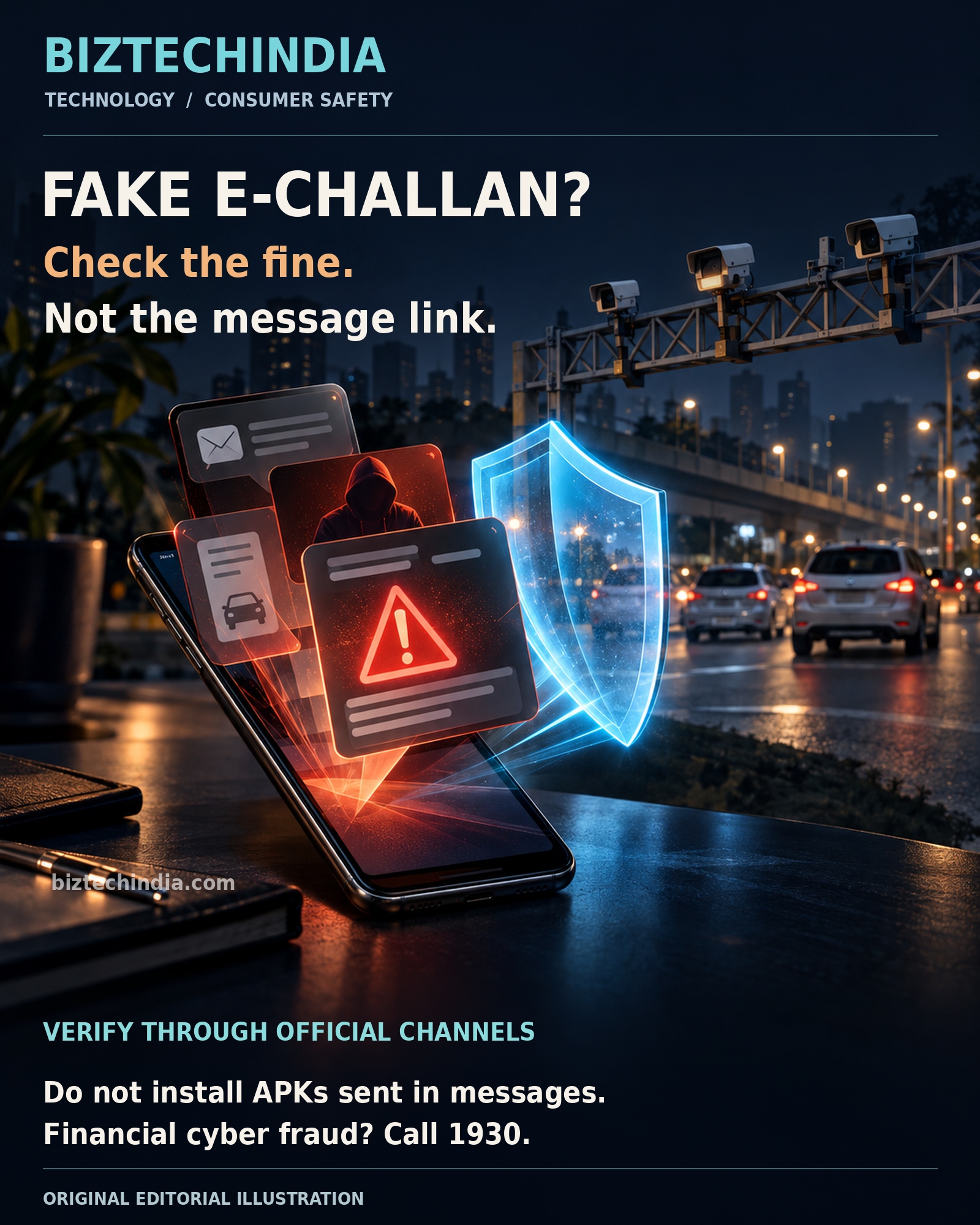
A traffic-fine message can show your real vehicle number and still be a scam. The safer response is to check the alleged fine independently, rather than let an urgent message choose the website or app you use.
A November 19, 2026 report in The Hindu describes motorists in Kerala losing money after responding to fake e-challan alerts. The report quotes an Ernakulam enforcement official warning that the state’s Motor Vehicles Department has not authorised an agency to send e-challan alerts through WhatsApp. It also says fraudulent messages can contain the recipient’s actual registration number.
This is a fresh reminder of an established threat, not a newly announced nationwide rule. CERT-In’s March 17, 2026 advisory already documented an Android malware campaign using RTO and e-challan messages as bait.
Two traps behind a familiar-looking fine
One trap is a payment or login page that imitates an official service. Another is an Android installation file, often ending in .apk, presented as a challan receipt or transport app. A real registration number, a familiar logo or a small fine amount does not authenticate either route.
CERT-In describes a multi-stage campaign in which an initial app prompts the user to install an update. The later malware can seek access to SMS and phone functions, run in the background and request a VPN connection. Fake financial screens can capture credentials while the malware reads OTP messages. These are the capabilities described in that advisory, not proof that every suspicious message uses the same malware.
Check the fine without following the message
- Pause before paying or downloading. Do not install an APK sent through WhatsApp, SMS, Telegram or an unfamiliar website.
- Open the official service independently. Type echallan.parivahan.gov.in into your browser, or use your state’s official traffic-police website or app. CERT-In identifies these as the routes for verifying challans. Check the full domain, not just a logo or the word Parivahan.
- Match the record before taking action. Use the official service’s challan-checking process and examine the details. If the message and official record disagree, seek clarification from the relevant transport authority through contact details obtained independently.
The point is not to ignore legitimate traffic fines. It is to separate the obligation to check a fine from an unverified sender’s demand to click, install or pay immediately. Do not forward a suspicious APK to relatives to ask whether it is genuine.
If you installed an app or money has left your account
CERT-In advises people who installed the malicious APK to disconnect mobile data and Wi-Fi, uninstall suspicious apps, run a trusted mobile-security scan, change affected passwords and UPI PINs, and check bank statements. Use a separate trusted device to contact your bank or secure accounts if the phone may be compromised. Uninstalling a visible app alone is not a guarantee that the device or accounts are safe.
For financial cyber fraud, contact your bank immediately and call 1930 or report through cybercrime.gov.in. The National Cyber Crime Reporting Portal confirms the 1930 helpline. Keep transaction references, messages, screenshots and other evidence for the complaint, without delaying urgent reporting. Reporting can help authorities respond, but it does not guarantee a refund.
What the reports do not establish
A scammer knowing a vehicle number does not, by itself, prove a breach of a government database. The Kerala report raises questions about possible misuse of transport-related data, but it does not establish a confirmed Parivahan data breach. Nor should a warning about fake messages be turned into a claim that every SMS about a challan is fraudulent.
The useful habit is simple: verify the fine through an official route you opened yourself, and never install a message attachment to find out whether you owe money.
Read news in English and Hindi with our free Wolf News app.
Recent Comments