Educational explanation only. I am not a SEBI registered analyst. No legal or investment recommendation.
India's newly released SAMPADA nutrition findings describe a large anaemia burden, alongside lower estimates than previous national surveys. The useful question is not simply whether the headline number is smaller. It is what was measured, in whom, and how severe the condition was in each group.
The Indian Council of Medical Research's National Institute of Nutrition conducted the community-based survey during 2023 to 2025. The government released its key findings on November 23, 2026. The survey covered more than two lakh people across 183 districts in 35 states and Union Territories, with more than 1.7 lakh blood samples analysed for haemoglobin.
Keep the population beside the percentage
The fact sheet estimates anaemia prevalence at 41.8% among children aged 12 to 59 months and 46.3% among adolescent girls aged 10 to 19. Among adolescent boys aged 10 to 19, the figure is 22.8%; among adult men aged 20 to 59, it is 22.0%.
For non-pregnant, non-lactating women aged 15 to 49, prevalence is 55.9%. Pregnant women and lactating women are reported separately, at 43.6% and 58.1% respectively. These are not interchangeable populations, and a rounded figure for women should not silently be applied to all women or every life stage.
The estimates also come with confidence intervals. They are survey estimates, not an exact headcount of every affected person in India.
Mild does not describe every group's majority
The government highlights that severe anaemia is below 2% in most age groups. The word "most" matters. The fact sheet reports severe anaemia at 2.1% among adolescent girls and 2.9% among non-pregnant, non-lactating women aged 15 to 49.
The severity split also prevents a blanket claim that anaemia is mostly mild everywhere. In that latter group of women, mild anaemia is 26.1% of the population, moderate anaemia 26.9%, and severe anaemia 2.9%. Moderate anaemia is therefore slightly more common than mild anaemia in this table.
Those percentages use the whole population group as the denominator. They should not be mistaken for percentages only among people with anaemia. The severity categories help describe the burden; they are not a reason to dismiss it.
A different measurement is not automatically a trend
SAMPADA used venous blood samples and automated analysers. Its fact sheet describes this as the gold-standard approach and identifies WHO 2024 haemoglobin cutoffs for defining anaemia across age, sex and physiological groups.
The government says the resulting estimates are lower than those of previous national surveys. That statement should not be turned into proof that a programme caused a particular reduction. This is a cross-sectional survey, not a controlled test of a programme.
Comparing surveys also requires checking blood-sampling methods, age bands and definitions. A figure for children aged 12 to 59 months, for example, does not describe the same age range as one beginning at six months. Without a like-for-like assessment, a simple subtraction can give a misleading impression of progress.
Anaemia and iron deficiency are not synonyms
The release says iron deficiency accounts for about half the anaemia burden among women, adolescent girls and children. It also identifies nutritional and non-nutritional causes, including infections, inherited haemoglobin disorders and inflammation associated with chronic disease.
The survey assessed micronutrient markers in a sub-sample. Its population findings do not establish the cause of anaemia in an individual, and they do not justify starting, stopping or changing a supplement without appropriate clinical advice.
The strongest reading of SAMPADA is therefore specific: a large national survey adds detailed evidence across life stages, but the age group, severity, testing method and denominator belong beside each number. Lower estimates and a continuing substantial burden can both be true.
This article explains public-health survey data. It is not a diagnosis, treatment recommendation or substitute for advice from a qualified healthcare professional.
Disclaimer
This article is for information and education only and is based on public sources. Please double check at the source before making any financial decision. We hold zero holdings in the companies mentioned in this article.
Our purpose is to promote financial literacy and resources, without any personal or monetary motive. We do not take or promote positions on misleading price information for personal gain. We do not use this platform to mislead any trader or investor, now or in the future.
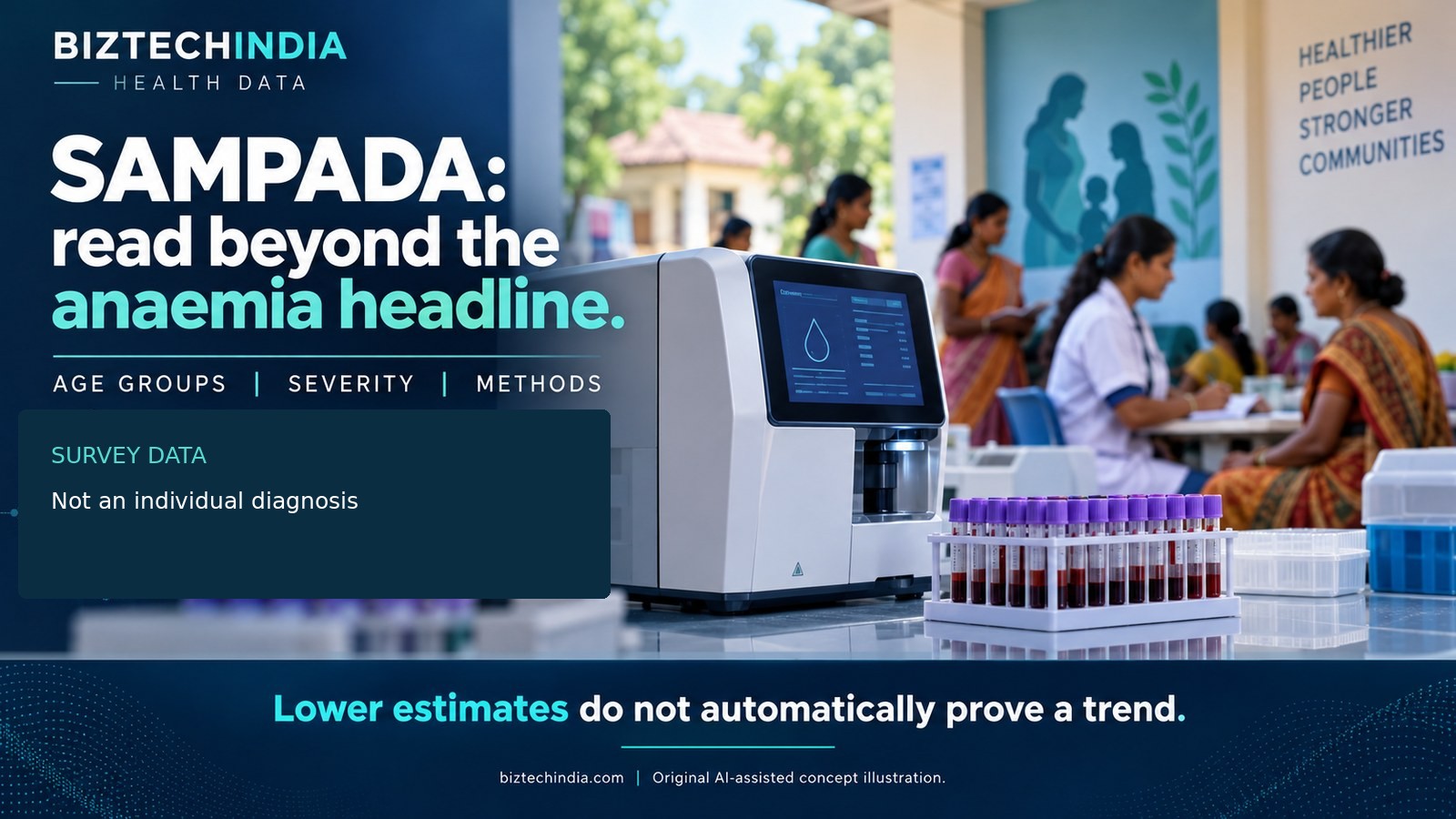
AI disclosure: This original explainer and concept illustration were prepared with AI assistance and source-checked on 24 November 2026. The illustration does not show an actual survey laboratory or participant.
Read news in English and Hindi with the free Wolf News app.
FOLLOW WOLF OF INDIA, FREE EVERYWHERE
WEBSITES
Wolf of Dalal Street: https://wolfofdalalstreet.com
Stockmarket360: https://stockmarket360.in
BizTechIndia: https://biztechindia.com
Jobat360: https://jobat360.com
Trending on Net: https://trendingonnet.com
Blog + daily digest: https://wolfofdalalstreetofficial.blogspot.com and https://wolfofindia.blogspot.com
APP
Free news app: https://wolfnews.surge.sh (turn on notifications)
YOUTUBE
Wolf of Dalal Street: https://www.youtube.com/@WOLFOFINDIA360
CHANNELS (free updates by message, our newsletter)
WhatsApp channel: https://whatsapp.com/channel/0029VaswZ107YSdBnLu1FY3g
Telegram (Wolf of India): https://t.me/WOLFOFINDIA
Telegram (Wolf of Dalal Street): https://t.me/wolfofdalalstreetofficial
Telegram (Stockmarket360): https://t.me/stockmarket360official
Telegram (BizTechIndia): https://t.me/biztechindia
Telegram (Trending Online): https://t.me/Trendingonlineofficial
WhatsApp Business (join, message preferred): https://wa.me/919619991645
PROFILES
LinkedIn: https://www.linkedin.com/company/wolfofdalalstreet/
Instagram: https://www.instagram.com/wolfofindiaofficial
Facebook: https://facebook.com/wolfofdalalstreetofficial
X: https://x.com/Wolf_India360
Reddit community: https://www.reddit.com/r/WOLFOFDALALSTREETJOIN/
Quora Space: https://wolfofdalalstreet.quora.com
Diigo: https://www.diigo.com/user/wolfdalalstreet
RSS FEEDS
https://wolfofdalalstreet.com/feed/ | https://stockmarket360.in/feed/ | https://biztechindia.com/feed/ | https://jobat360.com/feed/ | https://trendingonnet.com/feed/ | https://wolfofdalalstreetofficial.blogspot.com/feeds/posts/default
Market and business education only. Not investment advice. No tips, no targets.