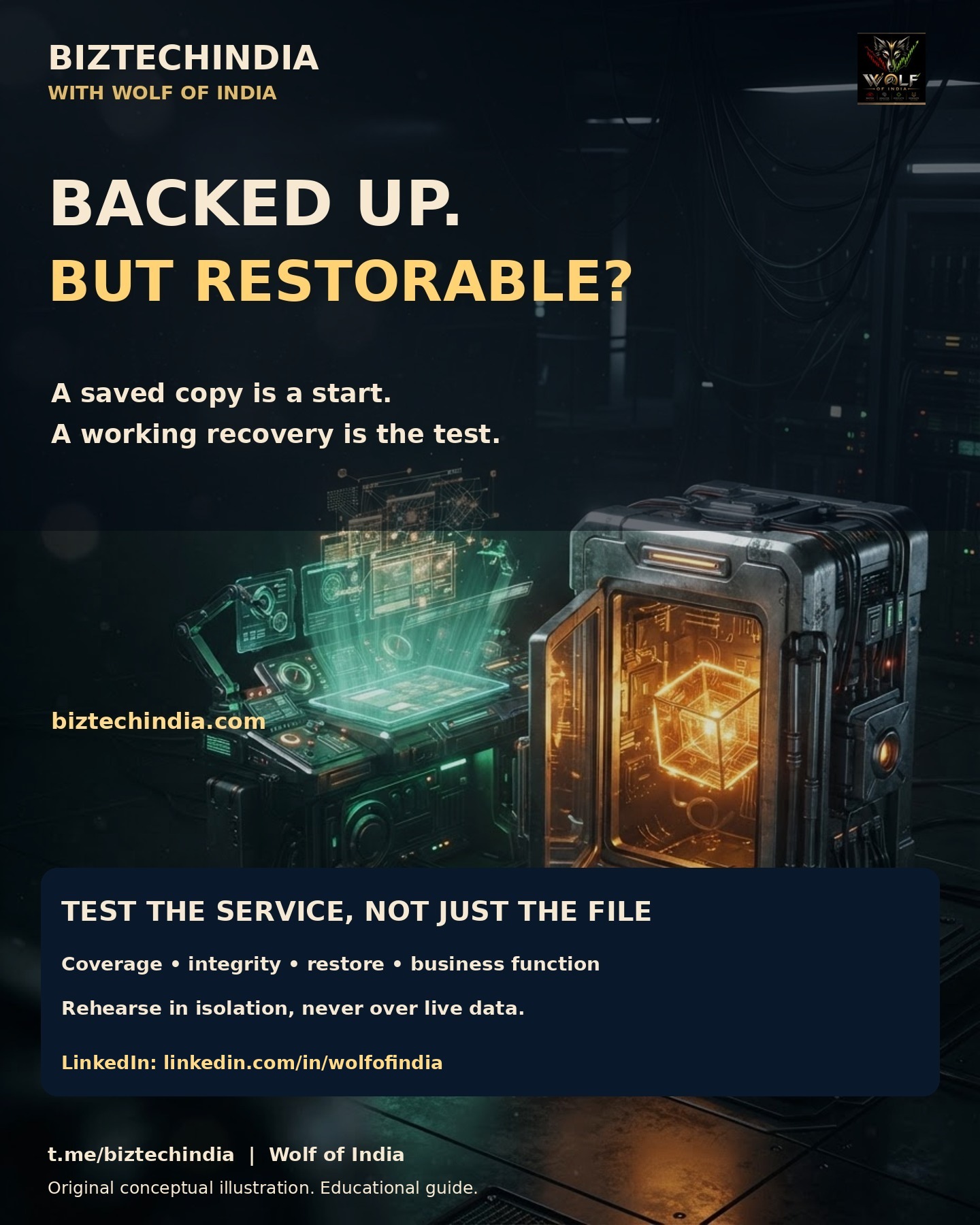
The dashboard says the backup succeeded. The service is still down. Those two statements can both be true: creating a copy and rebuilding a working system are different jobs.
A backup job can confirm that files were written without proving that the database can be restored, the application can start, authorised staff can sign in or customers can complete the task the service exists to perform. For a small business, a recovery test turns that uncertainty into an observable result.
Four questions behind one green tick
| Check | What to establish |
|---|---|
| Coverage | Does the copy include the information and configuration needed? |
| Integrity | Can the stored data be read and checked for corruption? |
| Restoration | Can it be recovered into a suitable environment? |
| Service | Does the recovered system perform its intended business task? |
CISA’s small-business backup guidance recommends taking an inventory, protecting important copies and conducting recovery tests. Its examples include financial records, communications, configuration files, website data and operational databases. A folder of uploaded images is not a complete website recovery plan if the posts, accounts and settings live in a separate database.
A fictional shop’s recovery rehearsal
Imagine a small online shop. At 9:00 AM it makes a copy of its database and files. At noon the team restores that copy into an isolated test environment. The restored homepage loads, but the product images are missing because their storage location was outside the backup job.
The original backup task did not necessarily report a software error. It may have copied exactly what it was configured to copy. The failure was the assumption that this scope represented the entire service. The rehearsal exposes that gap before a real incident forces the team to discover it under pressure.
Now suppose the images are included, but nobody can access the recovery account without an authenticator on a lost device. The data exists; the recovery route still does not work. Access, configuration, dependencies and documented responsibilities belong in the test, without putting passwords or recovery codes into a shared report.
Recovery point and recovery time answer different questions
A recovery point objective, or RPO, identifies the point in time to which data must be recovered after an outage. A recovery time objective, or RTO, sets a limit on the recovery phase before the business is negatively affected. Objectives are targets, not evidence that the current setup meets them.
In the shop example, a copy made at 9:00 AM cannot, by itself, contain orders created at 11:00 AM. A fast restore of that copy does not eliminate the missing interval. Conversely, a very recent copy is not enough if the team needs days to make the service usable. Backup frequency and recovery speed must be tested separately.
A practical test without touching production
- Choose a specific recovery goal, such as restoring one critical database and its application files.
- Use an isolated environment and suitable test controls. Do not overwrite the live service as a rehearsal.
- Record the backup date, the included components and the start of recovery.
- Restore, check integrity and verify the business function with non-sensitive test data.
- Record missing dependencies, permission problems, elapsed time and the person responsible for fixing each gap.
- Repeat after fixes and after material changes to the service.
Disable or safely contain outbound email, payments and integrations in a restored test system. A cloned application can otherwise contact real customers or external services. If you cannot establish a safe test boundary, stop and arrange qualified help rather than experimenting on live customer data.
Keep a copy outside the same failure
CISA describes the 3-2-1 approach: three copies, two storage-media types and one off-site copy. It also recommends protections including encryption, offline copies and physical security. These are risk-reduction practices, not guarantees that any specific vendor or layout is immune to ransomware, theft or accidental deletion.
A copy reachable with the same compromised account may share the original’s risks. Understand who can delete backups, how retention works and how recovery access is maintained. Before restoration after an incident, do not assume the latest copy is clean merely because it is recent.
Keep the evidence useful
A useful recovery record is short but concrete: which system, which copy, which environment, which checks passed, how long it took and what remains unresolved. A file checksum can support an integrity check; it does not prove the recovered application works. A homepage screenshot proves one visible view; it does not prove orders, permissions or reporting are correct.
The stronger question is not whether the backup light is green. It is whether the team can demonstrate a safe, usable recovery of the service it depends on.
Source and method
Source checked 27 November 2026: CISA, Back Up Business Data. Terminology also checked against the NIST glossary entries for RPO and RTO, which identify NIST SP 800-34 Rev. 1 as their source. CISA is a US cybersecurity agency; this article uses its technical guidance, not as a claim about an Indian legal requirement. The shop and its times are original hypothetical examples, not this publisher’s infrastructure or a real customer’s incident. This original article and conceptual illustration were created with AI assistance. No account, server or backup configuration was changed to write it.
Disclosure: For information and education only, not investment advice. We are not a SEBI-registered analyst. Double-check original sources before financial decisions. We hold zero shares in companies mentioned in this article. We do not take or promote positions on misleading price information for personal gain, or use this platform to mislead traders or investors. Our purpose is financial literacy and access to information, without a personal or monetary motive behind the information shared.
FOLLOW WOLF OF INDIA, FREE EVERYWHERE
WEBSITES
Wolf of Dalal Street: https://wolfofdalalstreet.com
Stockmarket360: https://stockmarket360.in
BizTechIndia: https://biztechindia.com
Jobat360: https://jobat360.com
Trending on Net: https://trendingonnet.com
Blog + daily digest: https://wolfofdalalstreetofficial.blogspot.com and https://wolfofindia.blogspot.com
APP
Free news app: https://wolfnews.surge.sh (turn on notifications)
YOUTUBE
Wolf of Dalal Street: https://www.youtube.com/@WOLFOFINDIA360
CHANNELS (free updates by message, our newsletter)
WhatsApp channel: https://whatsapp.com/channel/0029VaswZ107YSdBnLu1FY3g
Telegram (Wolf of India): https://t.me/WOLFOFINDIA
Telegram (Wolf of Dalal Street): https://t.me/wolfofdalalstreetofficial
Telegram (Stockmarket360): https://t.me/stockmarket360official
Telegram (BizTechIndia): https://t.me/biztechindia
Telegram (Trending Online): https://t.me/Trendingonlineofficial
WhatsApp Business (join, message preferred): https://wa.me/919619991645
PROFILES
LinkedIn: https://www.linkedin.com/company/wolfofdalalstreet/
Instagram: https://www.instagram.com/wolfofindiaofficial
Facebook: https://facebook.com/wolfofdalalstreetofficial
X: https://x.com/Wolf_India360
Reddit community: https://www.reddit.com/r/WOLFOFDALALSTREETJOIN/
Quora Space: https://wolfofdalalstreet.quora.com
Diigo: https://www.diigo.com/user/wolfdalalstreet
RSS FEEDS
https://wolfofdalalstreet.com/feed/ | https://stockmarket360.in/feed/ | https://biztechindia.com/feed/ | https://jobat360.com/feed/ | https://trendingonnet.com/feed/ | https://wolfofdalalstreetofficial.blogspot.com/feeds/posts/default
Market and business education only. Not investment advice. No tips, no targets.
Disclaimer
This article is for information and education only. Its example uses invented data, not public-source company results. It is not investment advice or a buy/sell recommendation. Please double check information at the original source before making any financial decision and consult applicable SEBI rules and investor-protection guidance. We hold zero holdings in the companies mentioned in this article; this invented example does not name any companies. Our purpose is to promote financial literacy and resources, without any personal or monetary motive. We do not take or promote positions on misleading price information for personal gain. We do not use this platform to mislead any trader or investor, now or in the future.