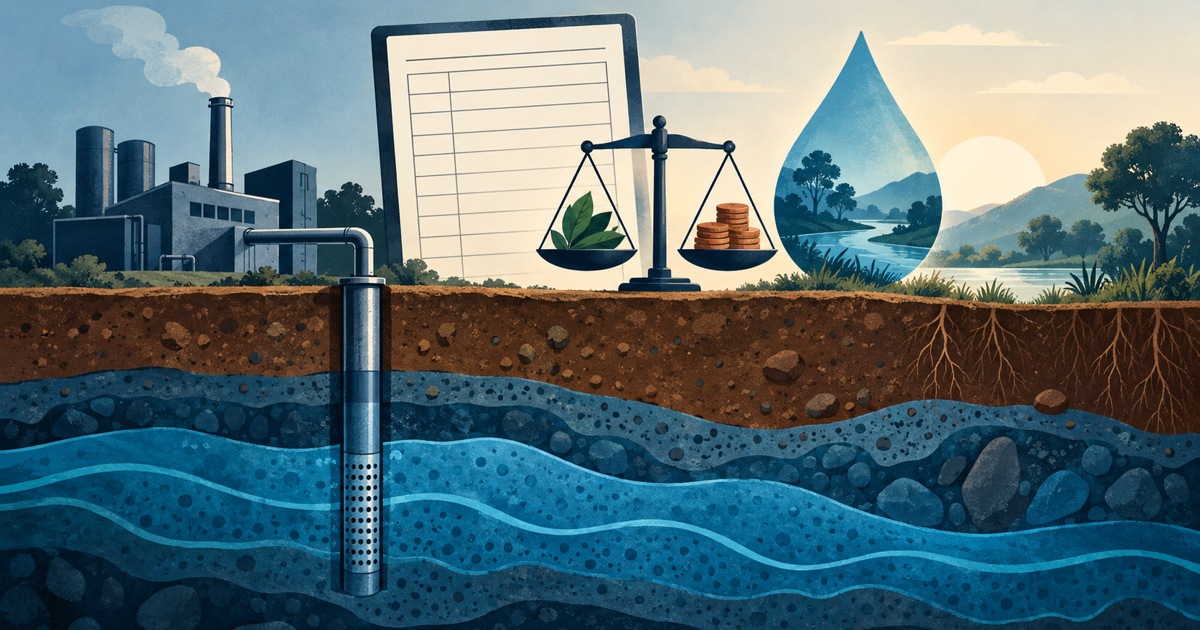
November 18, 2026: A new Central Ground Water Authority settlement scheme offers eligible projects a one-time route to reduce outstanding environmental compensation for specified groundwater violations. The largest relief is 75%, but that is a ceiling for one category, not a uniform discount or permission to pump groundwater without approval.
The Ground Water Charges (Dispute Resolution) Scheme, 2026, notified through S.O. 6179(E), balances two difficult tasks: recovering compensation tied up in disputes and bringing groundwater users into the regulatory system without making future violations cheaper. Its success will depend on actual recovery and compliance, not the size of the advertised relief.
Three kinds of violations, three relief ranges
The Gazette divides eligible cases into the following groups. The exact percentage depends on the groundwater assessment category and daily water-consumption slab.
- Existing projects operating without a no-objection certificate (NOC): 30-60% relief.
- Late applications to renew an NOC: 40-70% relief.
- Extraction above the quantity allowed in an NOC: 45-75% relief.
The matrices distinguish safe, saline, semi-critical, critical and over-exploited assessment units. Their consumption bands are below 200, 200 to below 1,000, 1,000 to below 5,000, and 5,000 or more cubic metres a day. One cubic metre is one kilolitre. A project cannot choose its relief percentage independently of its category and consumption band.
For example, in the no-NOC group, a project extracting 5,000 cubic metres a day or more in an over-exploited assessment unit has a 30% relief rate. In the same group, the safe-and-saline row provides 60%. That difference is why a headline saying only “75% relief” leaves out an important part of the policy.
Who is covered, and who is not?
The scheme covers eligible projects in the 19 states and Union Territories where CGWA regulates groundwater. It is not an automatic nationwide settlement of every groundwater demand. Infrastructure, industrial, mining and other existing projects can come within its scope, but must still satisfy the basic eligibility conditions in the applicable groundwater guidelines.
The annexure lists Assam, Arunachal Pradesh, Bihar, Chhattisgarh, Gujarat, Jharkhand, Madhya Pradesh, Maharashtra, Manipur, Meghalaya, Mizoram, Nagaland, Odisha, Rajasthan, Sikkim, Tripura, Uttarakhand, Andaman and Nicobar Islands, and Dadra and Nagar Haveli & Daman and Diu.
Fresh and renewal applications are covered. Earlier rejection or an application already pending with CGWA does not by itself rule out relief, but neither removes the underlying eligibility requirements. The authority may use valid documents such as consent-to-establish or consent-to-operate records to establish that a project existed before the scheme was announced.
Finally adjudicated environmental-compensation cases are excluded. The exclusion also covers compensation imposed by the National Green Tribunal in matters under challenge before the Supreme Court. Pending litigation has a separate conditional settlement process; it should not be confused with a blanket reopening of decided cases.
The payment conditions matter as much as the percentage
Applicants must register on the BhuNeer portal. CGWA will communicate the amount through the portal and the applicant’s registered email. The entire payable amount must be paid in a single transaction within 60 days of communication of the charges. Missing that period removes eligibility for the relief.
There are also payment floors. Section 7(viii) refers to relief on actual environmental compensation or minimum environmental compensation under the guidelines, whichever is higher. Section 7(x) requires payment of environmental compensation after relief or actual groundwater charges, whichever is higher. The notified percentage alone is therefore not enough to calculate a project’s final bill; the authority’s communicated demand must be checked.
Where eligible litigation is pending, payment leads first to a provisional settlement. Final discharge requires satisfactory proof that the relevant proceedings have been withdrawn or disposed of within the period specified by the committee. Failure can rescind the provisional settlement and revive the original liability in full, with payments already made adjusted against it. The undertaking concerns the period and violation category being settled, not unrelated future grievances.
A one-year window, not a guessed closing date
The notification is dated November 12, 2026, and says the scheme starts on publication in the Official Gazette and runs for one year from that publication. The document also carries a November 17 digital publication identifier and signature. We are not assigning a calendar closing date from those different date markers. Applicants should confirm the operative deadline and their case-specific requirements with CGWA rather than rely on an inferred anniversary.
The 60-day payment period is a separate clock, triggered by communication of the charges. There is also a 60-day period to correct deficiencies after a deficiency memo is issued. Neither should be mistaken for the overall application window.
What the policy could achieve, and what it does not prove
A settlement can make an otherwise disputed demand collectible and give an eligible user a reason to enter the approval system. For businesses, that may reduce unresolved liability and uncertainty. For the regulator, the test is whether the scheme produces actual receipts, valid approvals and enforceable extraction limits.
The countervailing risk is an expectation that future non-compliance will also attract a discount. The notification explicitly rejects that precedent. Later violations can bring full environmental compensation, applicable penalties and borewell sealing. False information can also trigger penalties and recovery of full compensation.
None of this establishes that groundwater levels have improved, extraction has fallen or environmental damage has been repaired. Those are separate outcomes that require evidence. In the wider development debate, a simpler settlement process and credible conservation safeguards need to be assessed together.
Before an eligible project applies
- Confirm the regulator, project eligibility, assessment-unit category and consumption slab.
- Check the violation period, original compensation calculation and all payment floors, rather than applying a headline discount to an old demand.
- Review any court or tribunal history before treating a case as eligible.
- Track portal communications, deficiency notices, payment and litigation-disposal conditions separately.
- Keep future extraction within the valid approval and comply with the continuing groundwater rules.
This is an educational policy explainer, not legal advice or confirmation that an individual project qualifies. BizTechIndia does not process applications or collect scheme payments.
Sources and related reading
Official Gazette: S.O. 6179(E), Ground Water Charges (Dispute Resolution) Scheme, 2026 (scope, exclusions, relief matrices, payment and enforcement conditions); BusinessLine’s independent report.
For more educational coverage across our network, visit Wolf of Dalal Street, Jobat360 and TrendingOnNet. Explore the free English and Hindi news app at Wolf News.