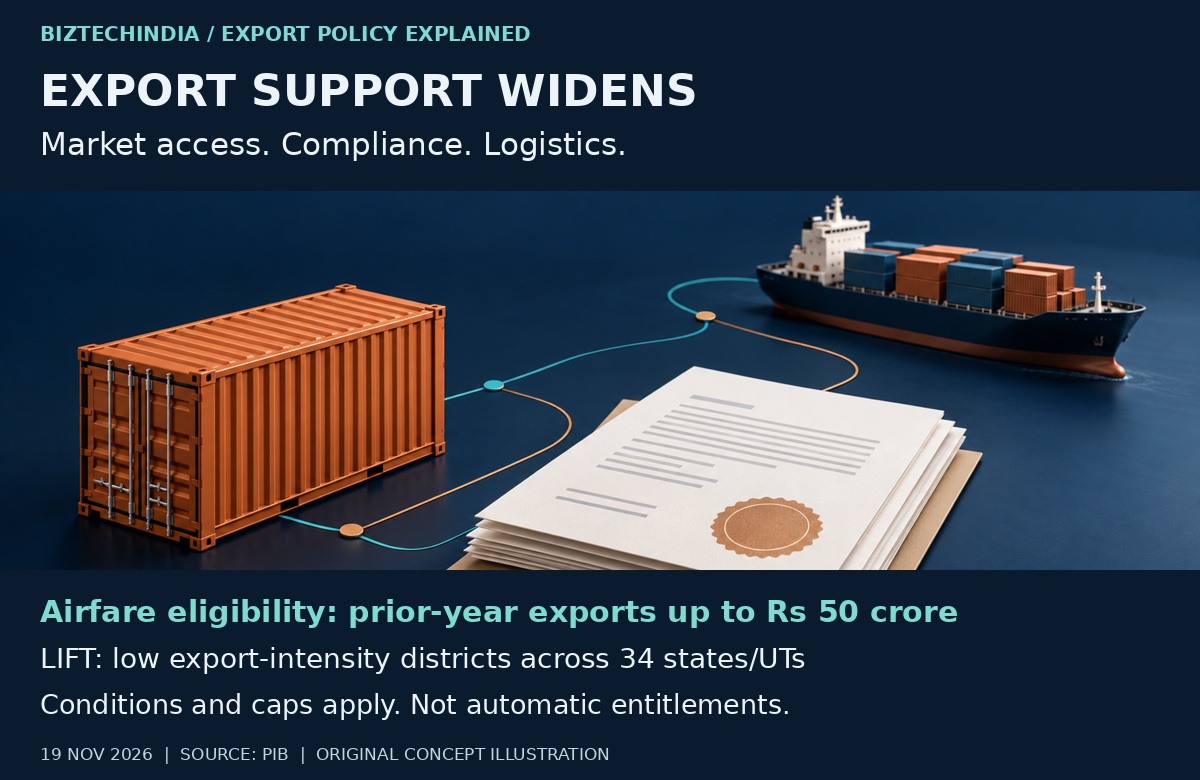
November 19, 2026: India’s export-support rules have been widened across market access, compliance and logistics, according to a Department of Commerce announcement published by PIB on November 18. The amendments were made on November 17 under Niryat Disha, part of the Export Promotion Mission.
The changes could bring more exporters within the scope of particular support measures. They should not be read as an automatic payment promise. Turnover thresholds, reimbursement percentages and geographical coverage describe different eligibility tests, while the applicable guidelines still determine whether an expense qualifies and how much can be reimbursed.
Market access: a much higher airfare eligibility ceiling
Under Market Access Support, or MAS, the maximum preceding-year export turnover for airfare-reimbursement eligibility rises from Rs 75 lakh to Rs 50 crore. PIB links that change to participation in buyer-seller meets, trade fairs and trade delegations. The figure is an export-turnover threshold for this support, not a grant of Rs 50 crore to each business.
The announced airfare-reimbursement rate is up to 95% for micro and small exporters and up to 80% for other eligible exporters. The words “up to” matter: a percentage is not an assurance that every ticket or every part of a travel bill will be paid. Applicable monetary caps and the rules for the relevant activity still matter.
The mandatory Export Promotion Council membership period is reduced from six months to three months, according to the announcement. That shortens one stated eligibility period; it does not mean that a newly formed business automatically qualifies for every market-access activity.
Compliance: more listed certificates, not a waiver of standards
Trade Regulations, Accreditation & Compliance Enablement, or TRACE, supports MSMEs facing overseas quality, safety and technical requirements. PIB says the list of certificates eligible for reimbursement expands from 462 to 600.
This is a change in the scope of support for compliance costs. It does not remove a destination market’s standards or certify that a particular exporter meets them. The practical distinction is between help with an eligible compliance expense and permission to sell a product in a regulated market.
For a small exporter, certification and conformity assessment can be a separate hurdle from finding a buyer. A wider support list may help address that hurdle, but the announcement alone does not establish that a particular firm’s certification cost will be accepted or reimbursed in full.
Logistics: broader reach for low export-intensity districts
The Logistics Interventions for Freight and Transport measure, or LIFT, is aimed at locational disadvantages and transport-cost gaps. PIB says coverage of low export-intensity districts expands from 13 states and Union Territories to 34. That is not the same as saying every district in those jurisdictions is eligible.
- Eligible port categories are expanded to include Land Customs Stations and Integrated Check Posts.
- Waterways are added alongside road, rail and air transport.
- Air-freight support is extended to Jammu & Kashmir and Ladakh, in addition to the North Eastern Region.
- The stated minimum distance eligibility criterion between origin and destination ports falls from 200 km to 100 km.
- Merchandise coverage is extended to all exportable items except those on the specified negative list of export products or categories.
These changes address different parts of the logistics problem. More transport modes and border facilities can widen the routes considered, while a lower distance threshold can change which movements pass that particular test. Neither change should be turned into a claim that every shipment receives a freight subsidy.
The policy significance, without treating spending as an outcome
The amendments target several costs around an export order: meeting potential buyers, demonstrating compliance and moving merchandise. That makes them relevant to the broader goal of widening participation beyond established export centres, rather than only counting large firms’ shipments.
In the context of Viksit Bharat, the test is whether more smaller and regionally dispersed businesses can participate in trade on workable terms. A wider eligibility framework is a policy step toward that objective, not evidence that new orders, jobs or export growth have already materialised. Those outcomes need later implementation and performance evidence.
The mission’s Rs 25,060 crore outlay for FY 2025-26 through FY 2030-31 is background, not a new funding allocation announced with these amendments. PIB says the Cabinet approved the mission on November 12, 2025. The latest release should not be described as adding Rs 25,060 crore of fresh money.
What this announcement does not settle
This article is an explanation of the announced changes, not a filing guide. It does not set out an application deadline, promise retrospective coverage, identify a firm’s exact reimbursement or replace the current DGFT notices and operational guidelines. Exporters should verify the applicable rules before incurring costs in the expectation of reimbursement.
The key reading is conditional: more firms, expenses or routes may now fit parts of the framework, but eligibility and the amount payable remain separate questions. A higher headline ceiling should not be mistaken for unconditional support.
Educational policy reporting only. This is not an entitlement determination, legal advice or an investment recommendation. We are not a SEBI-registered investment adviser.
Sources and related reading
Department of Commerce announcement via PIB, November 18; The Economic Times report on the amendments. Numerical changes above are attributed to the official announcement. The article does not infer detailed claim procedures from the press release.
Read more educational coverage across Wolf of Dalal Street, Jobat360 and TrendingOnNet, or use the free English and Hindi Wolf News app.