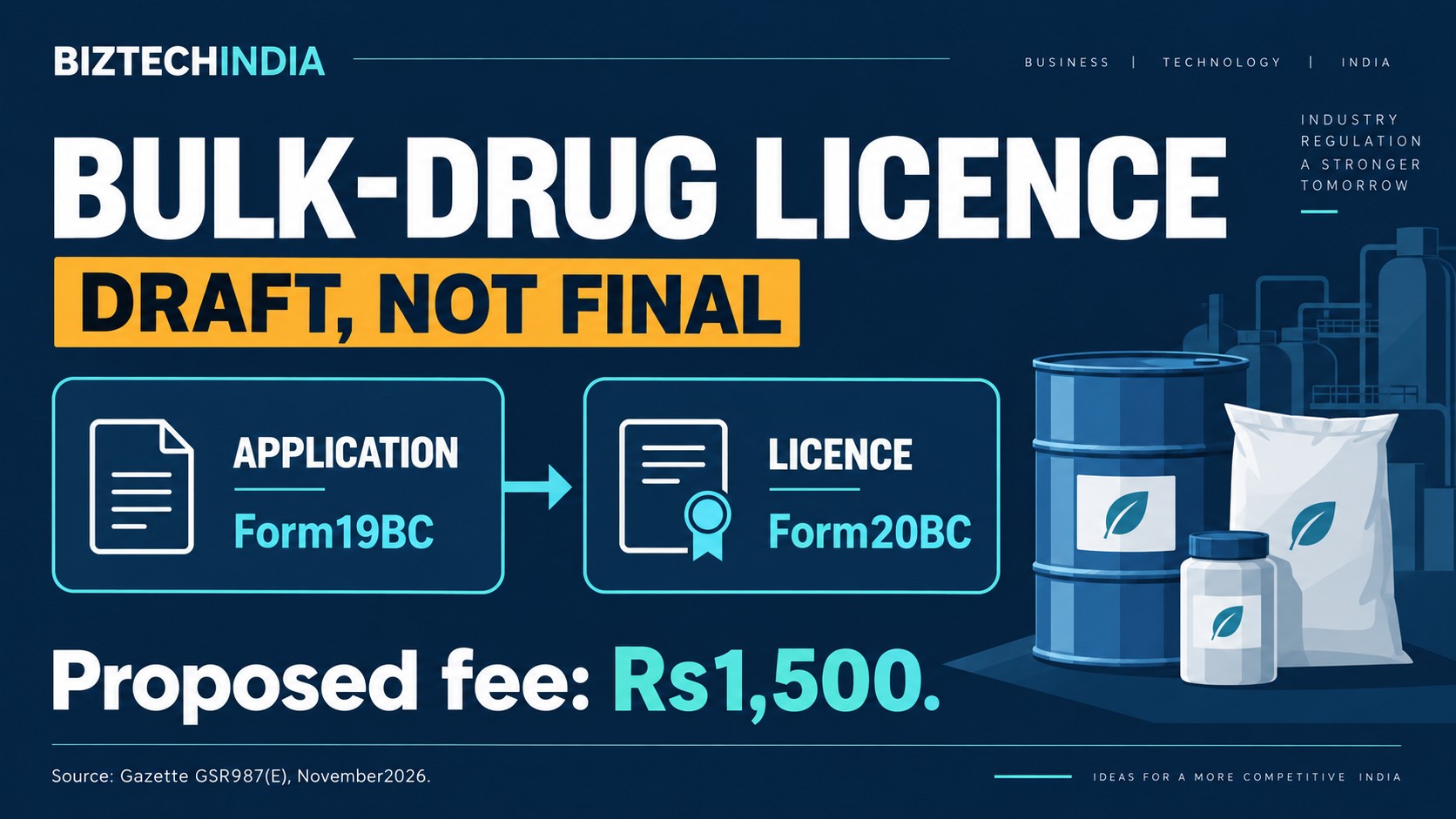
India’s Health Ministry has proposed a separate wholesale licence for bulk drugs, covering active and inactive bulk substances. The Gazette document is a draft amendment to the Drugs Rules, 1945, not a final rule that businesses must start following immediately.
The proposal would create a specific application and licence route, identify the person supervising sales, and place conditions on how bulk substances move between licensed businesses. For pharmaceutical supply-chain firms, the important distinction is between preparing for a possible change and treating that change as already in force.
What the draft would introduce
- Application: Form 19BC, accompanied by a proposed fee of Rs 1,500, submitted to the licensing authority.
- Wholesale licence: Form 20BC for selling, stocking, exhibiting or offering for sale, or distributing the covered bulk drugs by wholesale.
- Supervision: A competent person who is either a registered pharmacist or a science graduate with two years of experience dealing in these bulk drugs by wholesale.
- Scope disclosure: The application would identify the categories requested, list bulk drugs falling under the NDPS Act, 1985, and provide special-storage details where relevant.
The draft covers categories including Schedules C and C(1), substances outside those schedules, Schedule X, and inactive bulk drug substances. It should not be read as permission to handle every category merely by applying: the proposed licence records the categories and NDPS substances permitted under it.
Sealed containers and a traceable chain of purchase
One proposed condition says bulk drugs should be sold in the same intact containers supplied by the manufacturer. Another requires purchases from duly licensed dealers or manufacturers under cash or credit memos.
The draft also restricts resale to persons holding the required licence and sales for drug formulation to persons with the required manufacturing licence. It contains specified exceptions, including government purchasing, research and certain non-medicinal uses. Those exceptions are qualified provisions, not a general exemption for all buyers.
As drafted, the licence would remain valid perpetually unless suspended or cancelled, but that would not mean compliance checks disappear. The proposed form provides for assessment at least once every three years, or as needed under a risk-based approach.
The proposed transition is tied to final publication
For existing holders of licences in Forms 20B, 21B or 20G, the draft proposes a transition upon expiry of the current retention period or after 12 months from final publication in the Official Gazette, whichever is later. For new wholesale-licence applicants, the proposed starting point is final publication.
These are proposed future triggers. The draft notification does not, by itself, start that transition clock or establish a new application obligation today. Businesses should not calculate an implementation deadline from its November draft dates.
Why the dates need careful reading
The notification is G.S.R. 987(E), dated November 2, 2026. The Gazette issue carries November 12, while its digital identifier contains November 18. These different markers should not be collapsed into an assertion that a final rule was issued today.
The notice invites objections and suggestions within 30 days of the Gazette copies being made available to the public. This explainer does not assign an exact consultation closing date, because the public-availability trigger has not been independently fixed here.
What supply-chain businesses can take from it
A useful preparation exercise would be to map the substances handled, existing licence categories, supervising staff qualifications, storage arrangements and purchase records against the draft. That is an editorial reading of the operational questions it raises, not a claim that these changes have already become mandatory.
A clearer bulk-substance licence route could matter to India’s manufacturing supply chain. The document alone does not establish lower medicine prices, better product quality, faster approvals or a measurable economic gain. Those outcomes would need evidence beyond the wording of a proposed rule.
Basis: the Health Ministry’s draft Gazette notification G.S.R. 987(E), read for this explainer on November 19, 2026. This is general policy information, not legal advice. Check the final notified text and the relevant licensing authority before making a compliance decision.