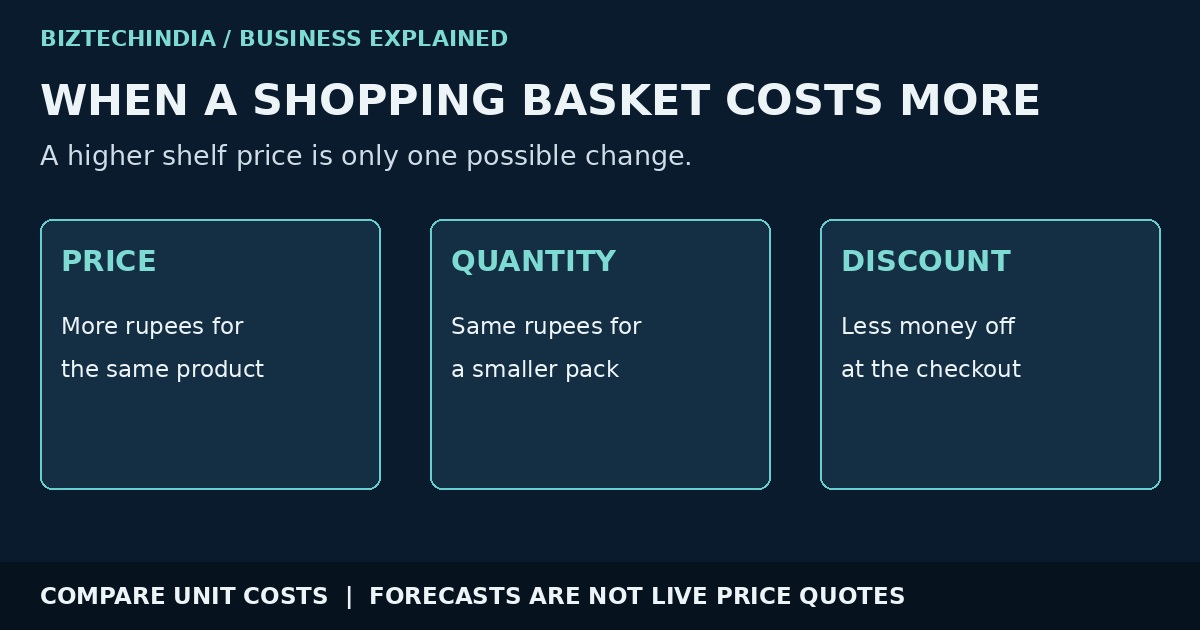
The next round of consumer price changes may not arrive as one obvious increase on a shelf label. It can also arrive as fewer grams in a familiar pack, a smaller discount or a more expensive replacement for an older product.
Reporting published by The Economic Times on November 17 describes consumer-goods companies preparing further price increases and smaller packs after the festive season. The pressures vary by category: memory chips affect phones and televisions, while appliances face commodity and freight costs. Food and household brands are dealing with ingredients and packaging.
The result is a pricing cycle that needs to be read product by product, rather than as one blanket inflation rate.
A cumulative increase is not a new overnight hike
The distinction matters most in electronics. The report describes recent handset and tablet price rises of up to 18% by Samsung and Xiaomi, an increase of up to 7% for Xiaomi televisions, and appliance increases of up to 7% at Haier and Godrej.
It also carries industry expectations that further revisions could take cumulative increases for the year above 40% for smartphones, above 20% for televisions and to 15-20% for appliances.
Those are different claims. A forecast for the combined effect of several rounds of price changes is not a claim that every phone will suddenly cost 40% more. The size and timing of any increase will depend on the model, brand and earlier price changes.
Nor does a manufacturer's price revision establish the final checkout price at every retailer. Discounts and available stock can change what a customer actually pays.
The pack-size question
For everyday products, the calculation is often less visible. A fixed-price pack can keep the same printed price while its contents shrink.
The Economic Times reported that Britannia had indicated further pricing action and reductions in the contents of some Rs 5 and Rs 10 packs. This is reported company commentary, not a claim that every product has already changed.
For shoppers comparing purchases, a unit-price calculation is more useful than the pack price alone. Comparing the cost per 100 grams, per litre or per item keeps different pack sizes on the same basis. A smaller cash payment can still buy a more expensive quantity.
Higher selling prices do not settle the business outlook
For companies, passing on costs can support margins. But it can also cause consumers to delay a discretionary purchase or switch to a cheaper option.
There is another moving part: input costs themselves. In a separate November 17 CNBC-TV18 interview, CLSA analyst Indrajit Agarwal described a possible improvement in consumer-durable margins as some commodity prices eased after earlier product-price increases. His assessment was conditional, not a guarantee of better profits.
That is why a single story about expensive raw materials cannot explain every company's outlook. Ingredients, components, inventory, competition and demand can move at different speeds.
For households, compare the item and quantity actually being bought. For readers following businesses, separate announced pricing, realised selling prices, sales volumes and profit margins. They are related measures, but none is a substitute for the others.
Educational business analysis only. Reported price changes and forecasts are not a live price quote or investment recommendation.
Image: original explanatory diagram.