India’s electronic-goods export basket is broadening, even as smartphones remain its largest component. A Commerce and Industry Ministry release dated November 17, 2026 puts exports at US$31.97 billion for April-September FY2026-27, up 44 percent from the comparable six months a year earlier.
The main shift is within that total. Non-smartphone electronics grew faster than smartphones and gained share. That is different from saying smartphone exports declined: their value also increased substantially.
Two growing segments, at different speeds
According to the ministry, non-smartphone electronic-goods exports rose 56.5 percent to US$13.79 billion from US$8.81 billion. Their share of the overall electronics export basket increased from 39.7 percent to 43.2 percent.
Smartphone exports grew 35.8 percent to US$18.17 billion from US$13.38 billion. They continued to account for the largest part of the basket, although their share eased from 60.3 percent to 56.8 percent.
This is how a category can export more while accounting for less of a growing total. Other categories expanded faster. A lower share does not necessarily mean a lower export value.
What sits outside smartphones?
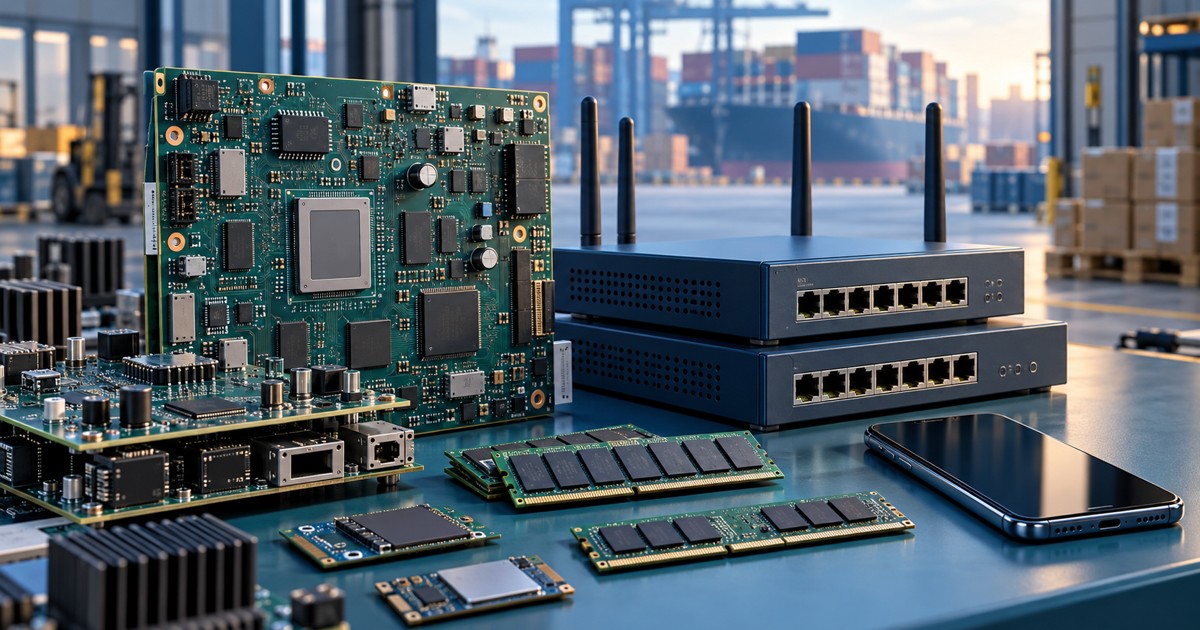
The release identifies growth in printed circuit boards, network equipment, memory integrated circuits and storage devices. These categories show why it is useful to look beyond finished phones when assessing electronics trade.
Network transmission and routing equipment exports, for example, increased from US$732.9 million to US$1.45 billion, a ministry-reported rise of 98 percent. Exports of mounted printed circuit boards rose from US$63.3 million to US$2.10 billion.
The ministry also reported memory integrated circuit exports of US$562.4 million, compared with US$23.1 million a year earlier. These are export values under the stated product categories. They are not a count of factories or proof that a new domestic chip fabrication plant has entered production.
Why the starting point matters
Some of the largest percentage increases come from relatively small earlier values. The mounted printed circuit board category, for instance, began the comparison at tens of millions of dollars rather than billions.
A large growth rate can still describe a real and important increase. But it needs to be read alongside the starting value and the current scale. It should not be treated as evidence that every part of the electronics industry is expanding at the same pace.
Destination patterns also differ by category. The ministry names Singapore as the leading destination for mounted printed circuit boards and Malaysia for memory integrated circuits. A destination for exported goods does not, by itself, identify the final consumer or establish where every manufacturing step took place.
Exports are not the same as domestic value added
The figures cover six months of export values. They do not measure all electronics produced in India, sales within India, the number of jobs created or the share of each exported product’s value generated domestically.
To assess the wider development contribution, those questions need their own evidence. An export-value increase alone cannot establish how much imported material a product contains, what wages were paid or whether a particular company’s profits improved.
For the Viksit Bharat development agenda, the reported broadening is a useful trade milestone. The next test is whether broader export participation is accompanied by sustained capability and value creation. Those outcomes should be measured, not assumed from the headline total.
What the half-year numbers do not forecast
April-September FY2026-27 is not a full financial year. These figures should not be doubled mechanically into a full-year forecast or turned into an unverified annual target.
Nor is the November 17 release breaking news on a later publication date. It is a dated official account of a completed six-month period.
The supported conclusion is clear enough: India’s reported electronic-goods exports increased, non-smartphone categories grew faster, and smartphones still grew while remaining the biggest segment. That is a diversification story, not a smartphone slump or a chip-fabrication announcement.
Export values, growth rates, shares and destination details are attributed to the Ministry of Commerce and Industry’s November 17, 2026 release. This is an informational explanation, not a forecast of company earnings or an investment recommendation.
From our network: For separate company announcements and market explainers, visit Stockmarket360. Sector export growth alone is not a reason to buy or sell a company’s shares.