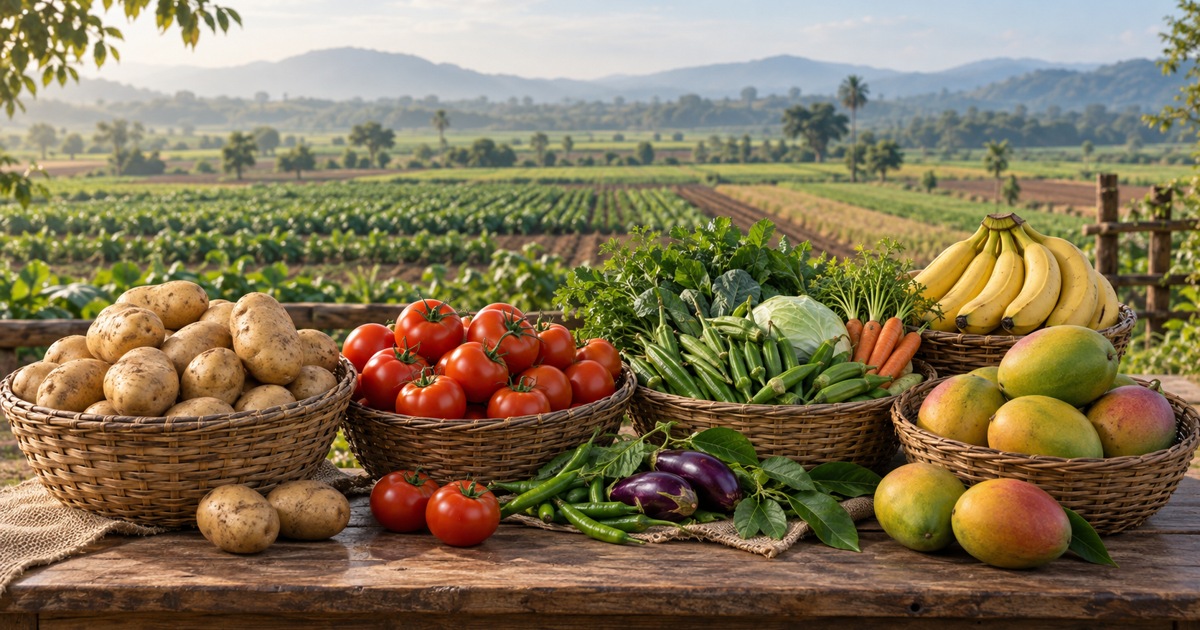
November 18, 2026: India’s horticulture output is estimated at about 386.9 million tonnes for 2025-26, up 4.36 percent from the previous year, even as the total estimated area under horticultural crops declined. That is the main finding of the Third Advance Estimates released by the agriculture ministry on November 17.
More output from less total area is a useful national signal. It is not, by itself, evidence that every crop used less land, every farmer earned more or consumers paid less for vegetables.
The headline numbers, with their estimate label intact
The official release puts horticulture production at 3,869.15 lakh tonnes, compared with 3,707.38 lakh tonnes in 2024-25. These correspond to about 386.9 million tonnes and 370.7 million tonnes respectively. The reported increase is 4.36 percent.
Total horticulture area is estimated at 297.21 lakh hectares, or 29.721 million hectares, against 301.36 lakh hectares, or 30.136 million hectares, in the previous year.
These are Third Advance Estimates, not final outcomes. The Department of Agriculture and Farmers Welfare compiled them using information from states, Union Territories and other government agencies.
Vegetables show why the total does not describe every crop
Vegetable production is estimated to rise 4.35 percent to 2,272.68 lakh tonnes, or about 227.3 million tonnes. Unlike the overall horticulture total, the area under vegetables is estimated to increase, from 117.91 lakh hectares to 119.31 lakh hectares.
That distinction is easy to miss in a short headline. Total horticulture area can fall while a major component expands. It would therefore be wrong to say all vegetables were grown on less land merely because the total horticulture area declined.
Potatoes show especially strong estimated growth: production is put at 655.70 lakh tonnes, or 65.57 million tonnes, up 11.95 percent from the previous year. Tomato production is estimated at 214.11 lakh tonnes, while onion output is estimated at 288.96 lakh tonnes.
Fruit and other segments also contribute
The ministry estimates fruit production at 1,230.66 lakh tonnes, or about 123.1 million tonnes, up 4.60 percent. Its release attributes the increase to better production of crops including banana, mango, papaya, apple, pomegranate and jackfruit.
Flower production is projected to rise 14.45 percent. Plantation crops are estimated to increase 7.56 percent, while aromatic and medicinal plants also show a projected increase. These are different segments, with different crops and area patterns, rather than a uniform expansion in every part of horticulture.
What more production does not establish
A national physical-output total is not a farm-income statement. It does not show the prices farmers received, their production costs or their net earnings. Those would need separate evidence before making a claim about income gains.
It is not a retail-price reading either. The estimates do not establish the price a household will pay in a particular city, market or week. A larger annual production estimate should not be presented as a promise that vegetables will immediately become cheaper.
Nor do the area and tonnage figures measure water use. Lower total cultivated area alone cannot establish lower water consumption. The release’s headline numbers do not provide a water-use comparison.
Read development claims separately from measured outcomes
Agriculture Minister Shivraj Singh Chouhan linked the projected performance to farmers’ work and government policies, and said it would support nutritional security and higher farmer incomes. Those are the minister’s assessment and expectations.
The output and area estimates do not isolate the contribution of a particular policy. They also do not demonstrate how any benefits are distributed across states, crops or households. For an account of India’s development, keeping that distinction visible is more useful than turning a production estimate into a claim that every wider outcome has already improved.
The grounded conclusion is that the ministry’s latest estimates point to higher horticulture production alongside lower total area, with vegetables expanding in both area and output. Farmer earnings, consumer prices and resource use remain separate questions.
Related reading: For separately verified recruitment explainers across our network, visit Jobat360.
Sources and units
- Agriculture ministry via PIB, November 17: Third Advance Estimates for 2025-26.
- Mint, November 17: coverage of the estimates.
- BusinessWorld, November 17: reported production and area comparison.
One lakh equals 0.1 million. Converted figures are rounded where labelled approximate; percentages are those reported in the official release. Estimate status applies throughout.