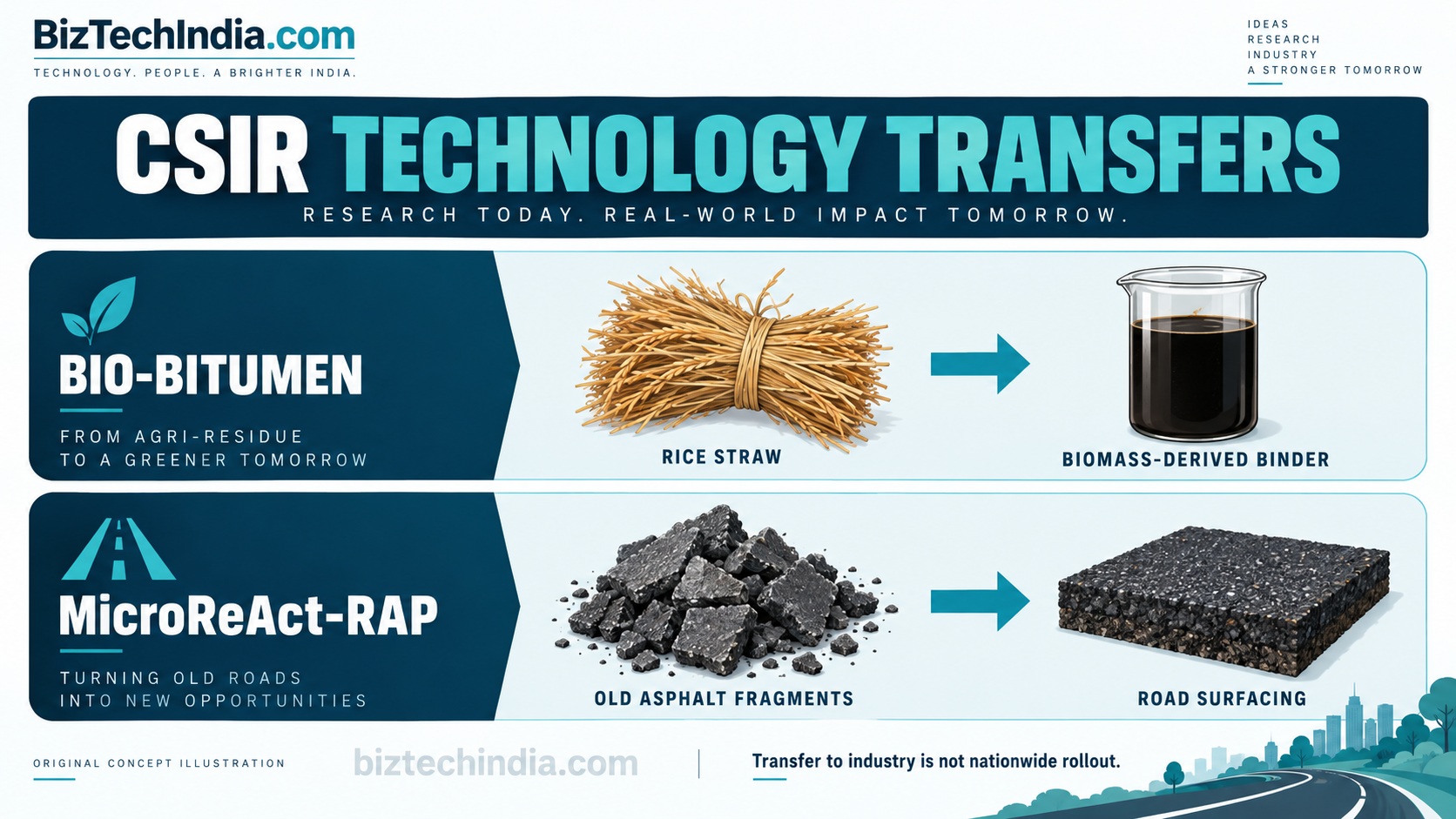
Crop residue and material recovered from old roads feature in a set of CSIR technology transfers announced on November 19, 2026. The announcement names industry partners for Bio-Bitumen and a reclaimed-asphalt micro-surfacing process, alongside technologies for concrete pavements, recycled construction products and restoring damaged power lines.
The important development is the transfer of research to partners for further use and commercialisation. It is not evidence that the technologies have just been invented, that they are already deployed nationwide or that their costs and environmental outcomes have been established at commercial scale.
Bio-Bitumen: agricultural residue as an input
According to the Press Information Bureau release, the Bio-Bitumen technology converts agricultural residues, including rice straw, into a biomass-derived material capable of partially replacing conventional petroleum-based bitumen. It was developed through collaborative work involving CSIR-Central Road Research Institute and CSIR-Indian Institute of Petroleum.
The named recipients are RAACS Solutions Private Limited, Bihar, identified with BioBhoomi, and SAR Parivahan Private Limited, Kolkata. The word partially matters: the release does not describe a universal replacement of petroleum bitumen in every road application.
MicroReAct-RAP: material from old roads
MicroReAct-RAP is described as a cold micro-surfacing solution incorporating up to 40% reclaimed asphalt pavement. The technology was transferred to Innovative Roadztech Private Limited, Delhi; AVK BlackGold Infra Private Limited, Surat; and Hindustan Colas Private Limited, or HINCOL, Mumbai.
The official statement says the process reduces the requirement for virgin aggregates and bitumen emulsion. Its “up to 40%” description is a stated maximum for this technology, not proof that every road project will use that proportion or achieve an identical outcome.
Concrete, construction products and power lines
CSIR-Structural Engineering Research Centre transferred Ultra-High-Performance Concrete pavement technology to the National Automotive Test Tracks, or NATRAX, specifically for pilot-scale field implementation. That pilot qualifier should not be lost when discussing its future use.
NATRAX also received recycled-aggregate-based technologies for bricks, hollow blocks and paver blocks. These are separate from the Bio-Bitumen and reclaimed-asphalt transfers and should not be combined into a single road product.
A further CSIR-SERC transfer went to IFAB Global: a lightweight, modular Emergency Retrieval System for power lines. It is designed to help restore electricity transmission lines after failures or disruptions. The announcement describes a technology transfer, not a completed restoration project or a guaranteed response time.
What still needs to happen after transfer
Licensing and transfer connect laboratories with organisations that can take a technology toward use. They do not, by themselves, establish how much a partner will produce, when a project will start or how a material will perform over years of service.
The next useful evidence will be partner implementation plans, field-test results, applicable specifications and project-level performance. This article does not attach cost-saving percentages, emissions estimates, kilometres deployed or stubble-burning reductions to the transfers because the reviewed announcement does not establish those outcomes.
The practical significance is a possible route from crop residue and recovered construction materials into new infrastructure inputs. The scale of that route remains a question for implementation, not something the transfer ceremony alone answers.
Original explainer based on the November 19 PIB announcement and IANS coverage, which draws on the same official statement. Technology descriptions and intended benefits are attributed to that announcement, not independent commercial-scale validation.
For English and Hindi explainers, visit the free Wolf News app.