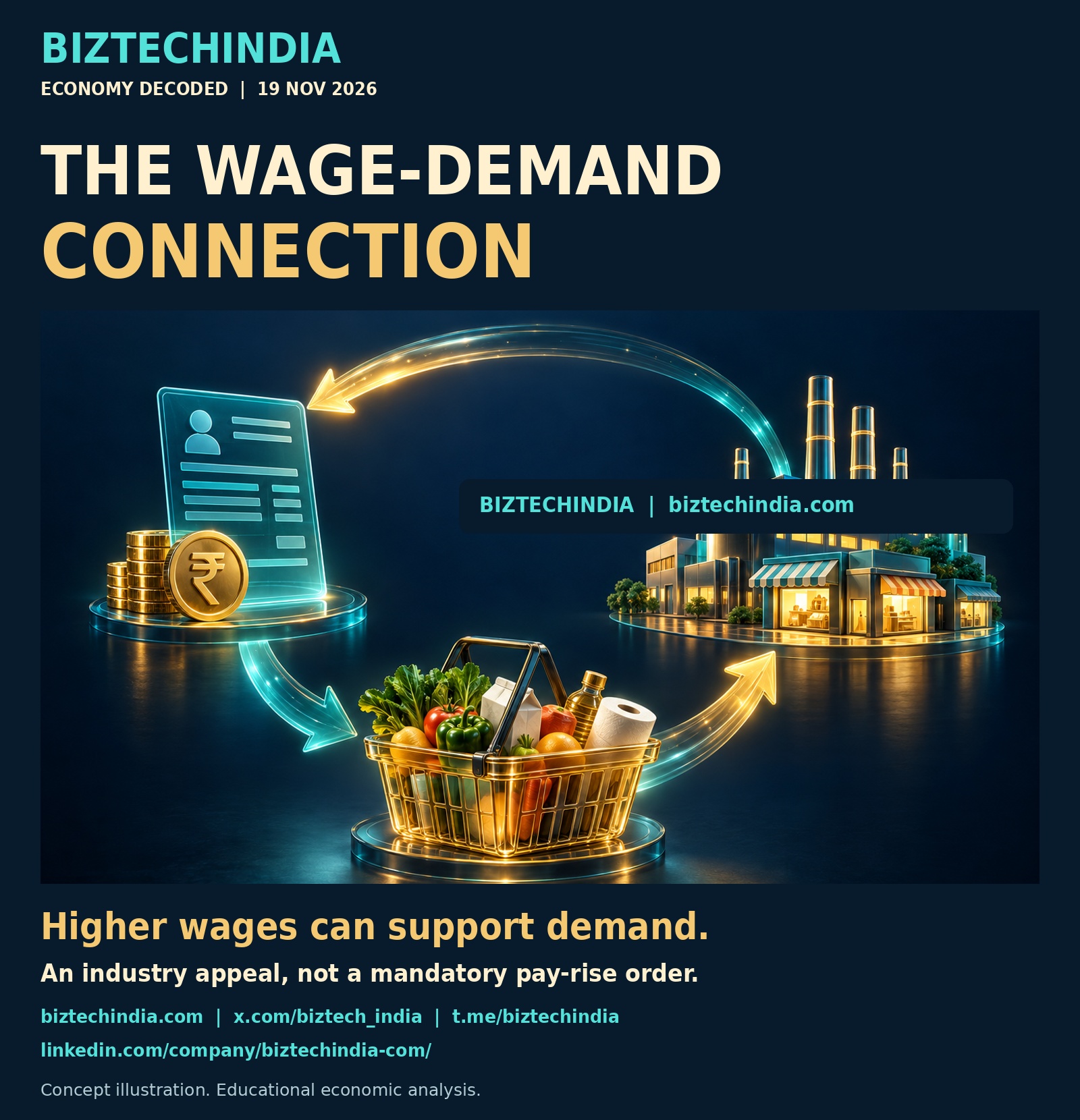
Higher wages are part of the demand story, not simply a cost line for employers. That was the economic argument put to industry by Department of Economic Affairs Secretary Anuradha Thakur at FICCI’s annual convention on November 19, 2026. Her appeal connects workers’ purchasing power with the customers businesses need for growth.
This was a policy discussion and an appeal to business leaders. It was not a new minimum-wage notification, a compulsory pay-rise order or a statistical release establishing a particular rate of wage stagnation across the economy.
The link between pay and the demand cycle
FICCI’s account of the address says rising incomes and improved living standards can strengthen consumption. ANI’s report describes Thakur drawing attention to wage stagnation and asking industry to examine what it can do. The point was presented as an economic interest shared by businesses and workers, rather than charity alone.
The mechanism is easy to describe without pretending it is automatic. Pay is an expense for an individual employer, but household income also supports spending across the economy. Better purchasing power can help demand for goods and services. Whether an individual business can increase wages, and what happens to prices, hiring or investment, still depends on its productivity, finances and market conditions.
A wider partnership agenda
The address also put government-industry partnership at the centre of the Viksit Bharat 2047 discussion. FICCI reports calls for renewed public-private partnerships and industry engagement across infrastructure, shipping, ports, defence and manufacturing.
Thakur also pointed to long-term finance, critical minerals, semiconductors and stronger links with smaller businesses. Technology transfer and liquidity support featured in that discussion. These are areas for collaboration identified in the speech, not a list of newly awarded projects or freshly sanctioned funding.
An assessment is not a new data series
FICCI’s release records the secretary’s assessment that private investment activity is reviving across a wider range of sectors. That should remain an attributed assessment. The speech does not, by itself, establish the scale of a nationwide capital-expenditure recovery or show that every industry and region is improving equally.
Similarly, a discussion of wage stagnation should not become an invented number for real wages, an assertion about every employee or a claim that all companies have withheld pay rises. Measuring those questions requires a defined population, time period and treatment of inflation. This explainer does not reproduce poverty or investment totals without checking the underlying data and definitions.
What would show progress
The useful follow-up is evidence: wage and employment data with clear coverage, actual company investment, and specific partnership decisions with disclosed terms. For businesses, the speech frames purchasing power and productive investment as connected questions. For workers, it is not a promise that a pay rise has been legally guaranteed.
The narrower conclusion is worth keeping: the DEA secretary has urged industry to consider wages, living standards and demand together while deepening its partnership with government. Whether the appeal changes company behaviour is a separate question that future evidence must answer.
For educational market coverage, explore Wolf of Dalal Street. English and Hindi explainers are also available through the free Wolf News app. This article is general economic information, not financial advice.