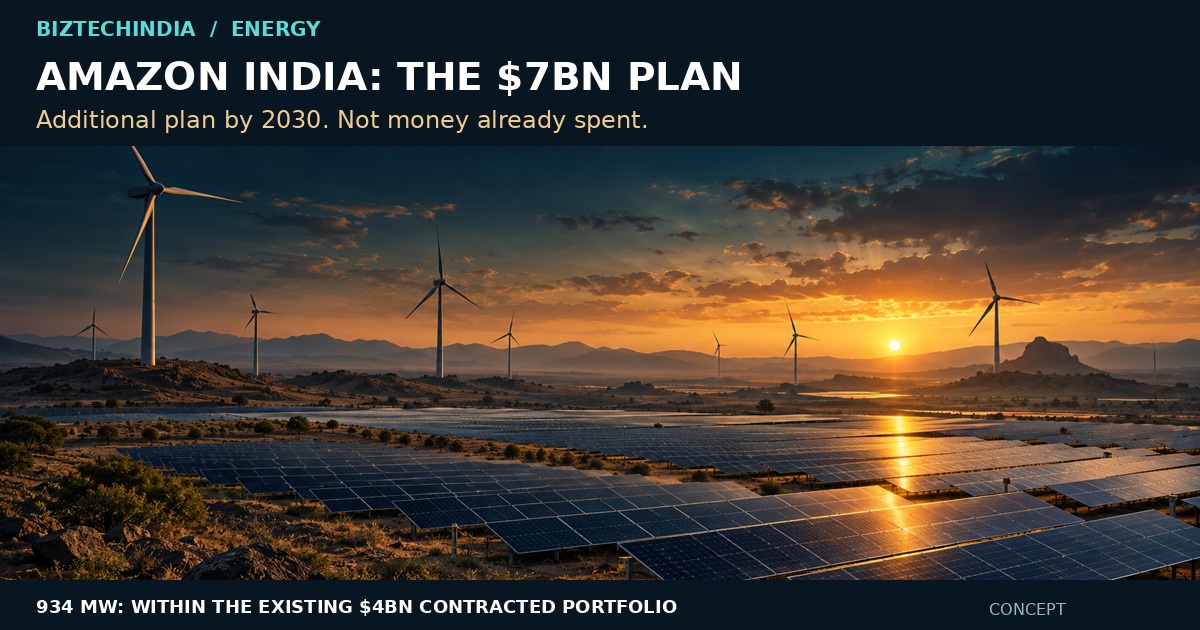
Amazon has announced a plan to invest an additional US$7 billion in renewable energy projects in India by 2030. The key to reading the announcement is to keep that future plan separate from the US$4 billion the company says it has already contracted.
The company set out the plan on 17 November 2026. It also announced four wind and solar projects with a combined capacity of 934 megawatts. Those projects belong to the existing US$4 billion contracted portfolio, not the additional US$7 billion plan. Counting them as a separate new investment pot would misread the announcement.
What is planned, and what is contracted?
The US$7 billion is a forward-looking investment plan through 2030. The US$4 billion describes renewable energy investments already contracted in India, according to Amazon. Contracted does not automatically mean every project is generating power, and neither figure should be presented as cash already spent in full.
The Hindu’s report separately describes the additional plan and the existing contracted investments. It also makes clear that the four newly announced projects are secured through power purchase agreements and sit inside the existing portfolio.
Where the 934 MW comes from
- Karnataka: a 234 MW wind farm, which Amazon describes as its largest wind project contracted in Asia to date.
- Karnataka: a separate 200 MW combined wind and solar project.
- Madhya Pradesh: a 300 MW solar project.
- Rajasthan: a 200 MW solar project.
These are capacity figures, not a measure of electricity delivered over a year. They also do not establish that all four projects are operating today. The announcement’s description of the portfolio exceeding 2 gigawatts is explicitly tied to projects becoming operational.
What a power purchase agreement tells readers
Amazon says the projects were secured through power purchase agreements, or PPAs. The announced relationship is therefore a contracted power-purchasing arrangement. Readers should not automatically turn that into a claim that Amazon owns and operates every wind farm or solar park involved.
The company compares the portfolio’s future generation with the annual electricity needs of more than 3.5 million Indian households. That is Amazon’s equivalence claim, not a promise that those particular households will receive dedicated power from the projects.
An intensity target is not the same as absolute emissions
The India announcement also links the investment to Amazon’s global goal of reducing the carbon intensity of electricity powering its operations by 65% by 2030, against a 2019 baseline. The company describes this as fewer associated carbon emissions per unit of electricity consumed.
That is a different measure from total emissions. The target should not be rewritten as a promise that all of Amazon’s emissions will fall by 65%, or that every hour of its operations will use only renewable electricity. Those would be broader claims than the announcement supports.
What would show progress next?
The useful follow-up evidence is project-specific: further contracts under the new plan, construction milestones, commissioning dates and reported electricity generation. An investment announcement records an intention and a set of commitments. Delivery needs its own evidence.
For now, the supported summary is an additional US$7 billion plan through 2030 alongside US$4 billion already contracted, with the four 934 MW projects inside that older contracted amount. Keeping the categories separate gives readers a clearer picture than treating every number as new money or completed capacity.
Image: original concept illustration of renewable energy infrastructure, not a photograph of the announced projects. Informational analysis, not an investment recommendation.