Global capability centres are usually described as multinational companies building teams in India. A newer part of the story is Indian businesses using the same model to organise their own operations.
Reporting published on November 16 describes domestic companies bringing technology, finance and human-resources work into dedicated centres. The purpose is not simply to move work to a lower-cost location. It is to stop different business units from solving the same problems separately.
That distinction matters for a conglomerate with multiple companies, locations and technology systems. A shared centre can provide common processes and specialist teams. Whether it actually delivers better results depends on how it is run, not on whether the organisation adopts the GCC label.
A large market, but not a domestic-company count
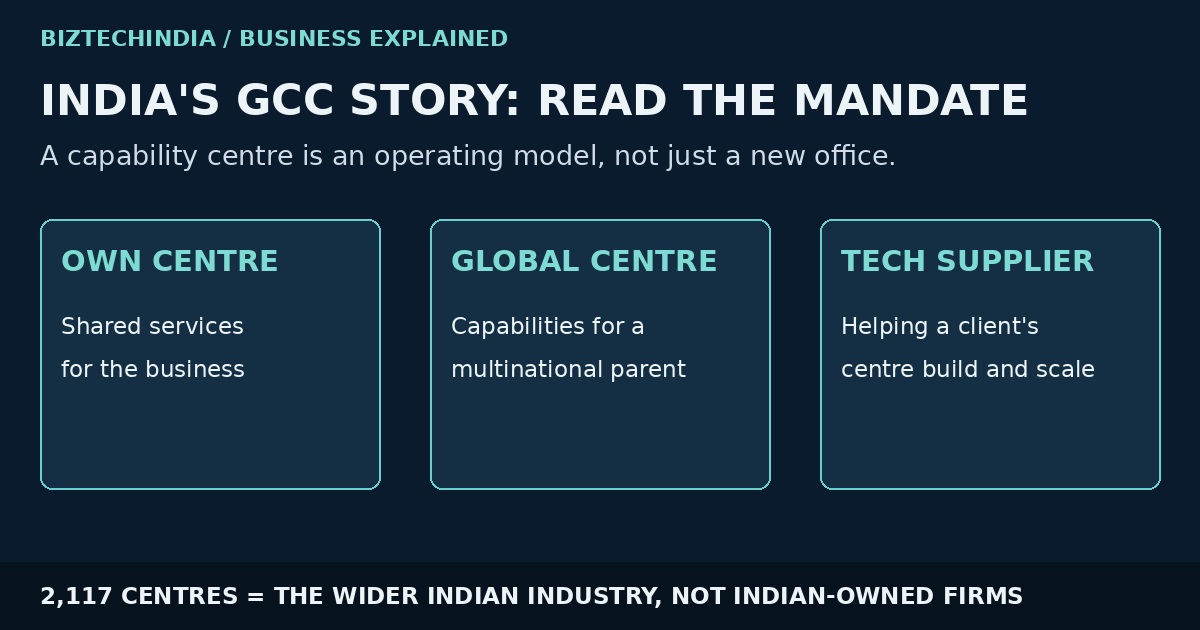
Nasscom's October 2026 GCC Runway Monitor describes an Indian industry with 2,117 centres, employing 2.36 million professionals and generating more than $98.4 billion in annual revenue.
Those are figures for India's wider GCC industry. They are not a count of centres owned by Indian companies, and they should not be used to suggest that thousands of domestic firms have just adopted the model.
The reporting on Indian-owned businesses describes an emerging pattern rather than a measured surge. The Times of India explicitly says no specific number captures the domestic-adoption trend. That limits the claims that can responsibly be made about its scale or growth rate.
Three models that should not be confused
A company's own shared-services centre, a multinational's Indian capability centre and an Indian technology supplier helping a client build a centre can all appear in the same discussion. They are connected, but they are not the same business model.
For example, ITC Infotech announced an expanded technology partnership with British American Tobacco in August. Its release said it would continue helping scale BAT's Future Capabilities Centre in India, while providing technology services across India, Poland and Romania.
That is evidence of a technology supplier supporting a client's capability centre. It is not evidence that ITC's entire domestic shared-services operation has become a new GCC, nor that the BAT centre was first announced this November.
Keeping those distinctions clear makes the opportunity easier to understand. A business can centralise work for its own use. It can build specialist capabilities that later serve outside clients. Or it can sell the expertise needed to establish and operate another company's centre.
Watch the mandate, not just the headcount
For readers following this trend, the useful questions go beyond the number of jobs announced. Which decisions will the centre own? Will it build technology or mainly process transactions? How will the parent company measure service quality and outcomes? Does the operating model allow specialist teams to improve work across the group?
A new office is easy to announce. An effective centre needs a clear mandate, accountable leadership and a reason for businesses to use its services. The next stage of India's GCC story will be shaped by those choices as much as by hiring or real-estate expansion.
Educational business analysis. This article does not make a company earnings forecast or investment recommendation.
Image: original explanatory diagram.