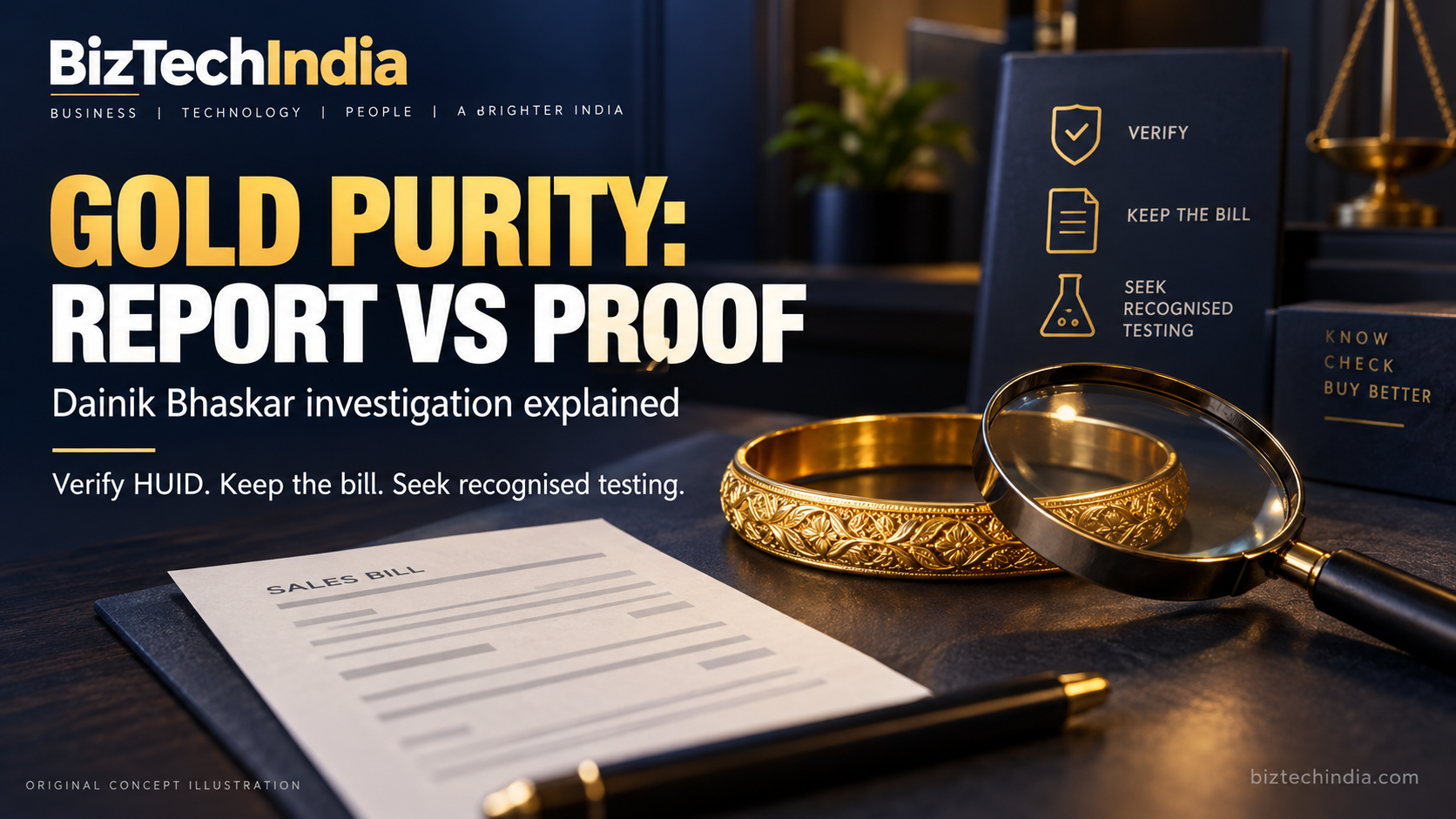
A Dainik Bhaskar investigation has reported suspected gold adulteration involving a powder sold as rhenium and a test ornament made in Jodhpur. The report raises a consumer-protection question, but it is not proof that every gold item is adulterated or that all hallmarking centres fail to detect impurities.
CNBC-TV18 has also covered the investigation, attributing its central findings to Dainik Bhaskar. That second account is coverage of the same investigation, not an independent repetition of the experiment. Buyers should keep that distinction in mind before treating a widely shared claim as a nationwide finding.
What the investigation reports
Dainik Bhaskar describes obtaining a sample through a dealer after contacting a supplier in China, then working with a jeweller in Jodhpur. It says a test mixture and a subsequently made ornament returned purity readings that did not match the amount of gold the reporters said had been used.
Those are the investigation’s claims about its sample, sourcing and tests. This publication has not independently obtained the powder, verified its composition or repeated the tests. The supplier’s claim that substantial quantities could escape detection is not a validated limit for every machine, testing method or jewellery item.
The reported connection to a supplier in China should also remain attributed. It does not establish the origin of every suspicious powder in the market, the scale of any distribution network or the purity of jewellery bought from a particular seller.
A report is a reason to verify, not to panic
The useful question for a buyer is whether their own article matches its declared purity and purchase record. A news report alone cannot answer that. Nor can a forwarded photograph establish the composition of an ornament that has not been tested.
There is no basis in the evidence reviewed here to declare all hallmarked jewellery unsafe, accuse every testing centre of wrongdoing or recommend that households rush to sell their gold. This article does not offer a home chemical test or identify a supposedly foolproof machine.
The checks BIS describes for consumers
The Bureau of Indian Standards’ consumer-protection page describes the BIS Care app’s Verify HUID feature for checking the authenticity of a hallmarked article’s identification record. Checking a record is different from independently measuring the chemical composition of the item in your hand. An app result should not be described as a fresh laboratory assay.
- Keep the invoice. BIS says the bill should include each article’s description, net precious-metal weight, purity in carat and fineness, and hallmarking charges. Preserve it for any dispute.
- Check the article and its record. Use the official BIS Care HUID check and compare the details carefully. BIS also advises checking hallmarking and fineness on each item in a pair and on detachable parts.
- Seek recognised testing if there is a concern. BIS says consumers can have jewellery or samples tested at a BIS-recognised Assaying and Hallmarking Centre on a chargeable basis. The centre is required to issue an assay report identifying the article’s markings.
Compensation depends on an established purity shortage
BIS states that when hallmarked jewellery bought by a consumer is found to have lower purity than marked, compensation is twice the amount of the difference calculated from the purity shortage and the article’s weight, plus testing charges. This is not twice the full purchase price, and a news report alone does not establish an individual claim.
The practical response is to preserve the article and its records, use recognised testing where needed, and distinguish a documented finding about your jewellery from a general allegation circulating online. That approach takes the report seriously without turning its limits into unsupported certainty.
Sources and scope
Dainik Bhaskar’s investigation; CNBC-TV18’s attributed coverage; BIS consumer protection; and BIS consumer FAQs. Checked November 19, 2026. This original explainer is not an independent laboratory finding, a valuation of any jewellery or an investment recommendation.