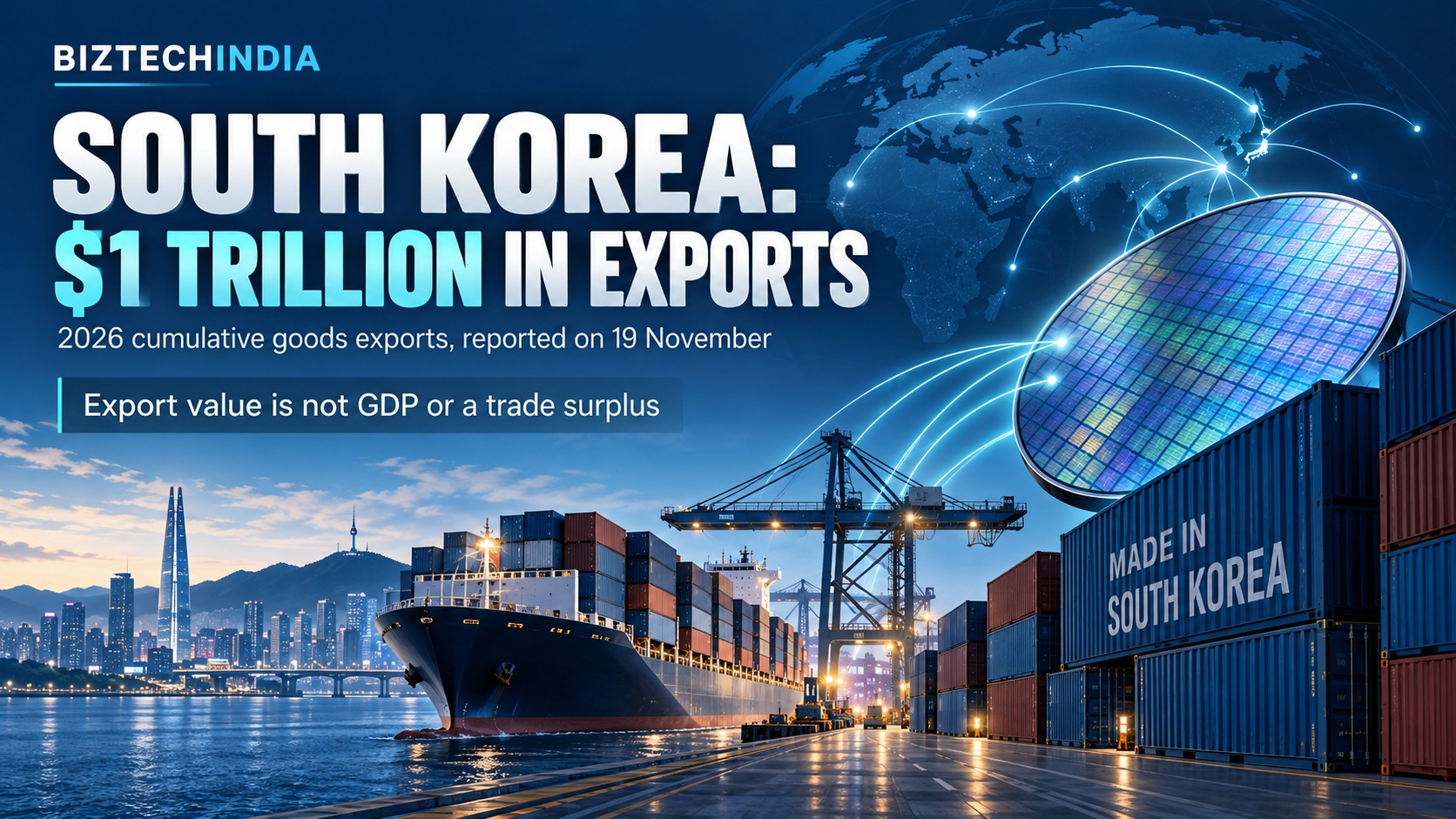
South Korea’s cumulative goods exports crossed US$1 trillion on November 19, 2026, according to Yonhap and The Hankyoreh, both citing the government’s provisional tally. The reports place the threshold crossing at about 2:09 PM Korean time.
The milestone measures the value of exports accumulated during the year. It is not South Korea’s GDP, a trade surplus, the combined value of imports and exports, or a forecast of the final year-end total.
What the trillion-dollar figure measures
A cumulative export figure adds up the value of outward shipments over a period. A trade balance instead compares exports with imports. GDP is a separate measure of economic output. Using one of these labels in place of another would change the meaning of the announcement.
Both reports described this as South Korea’s first crossing of the annual US$1 trillion export threshold. They said it was the fourth country to reach that milestone, after the United States, China and Germany. These are descriptions in the reports, not a new calculation of cross-country trade data by this publication.
AI-related demand and semiconductors are central to the story
Yonhap attributed the growth to strong demand for semiconductors and computers as global technology companies increased investment in AI infrastructure. It also reported the ministry’s view that higher memory-chip prices supported export values.
That price element matters when reading a value milestone. A higher dollar value can reflect changes in prices as well as the amount shipped. The trillion-dollar threshold should therefore not be described as proof that physical export volumes rose by the same proportion.
The two reports reviewed give different detailed semiconductor totals and shares for January-October. This article does not choose one of those conflicting figures or use them to calculate a precise chip contribution. Their common conclusion is that the semiconductor cycle and AI investment were important drivers.
The export mix matters alongside the headline
The reports also identify activity outside chips, including ships, petroleum-related products, cosmetics and pharmaceuticals. The government response described in the coverage includes efforts to broaden future growth areas and reduce reliance on semiconductors.
A record total and concentration risk can coexist. Strong demand in a major category can lift the aggregate while leaving exporters sensitive to a change in that category’s prices, demand or investment cycle.
What this does not establish for India
For readers comparing manufacturing and trade strategies, the useful questions concern product mix, pricing, customer markets and the durability of demand. This announcement alone does not establish that a particular Indian company will gain an order, that an Indian stock will rise or that one policy model can simply be copied.
Nor does an export-value record directly measure household income, job quality or how gains are distributed across firms. Those questions need their own data. The government’s stated ambition to spread the benefits of exports should be distinguished from evidence that this has already happened.
This original explainer reflects November 19, 2026 reporting by Yonhap and The Hankyoreh on a provisional government tally. It does not reproduce the conflicting detailed chip figures. This is educational information, not an investment recommendation.