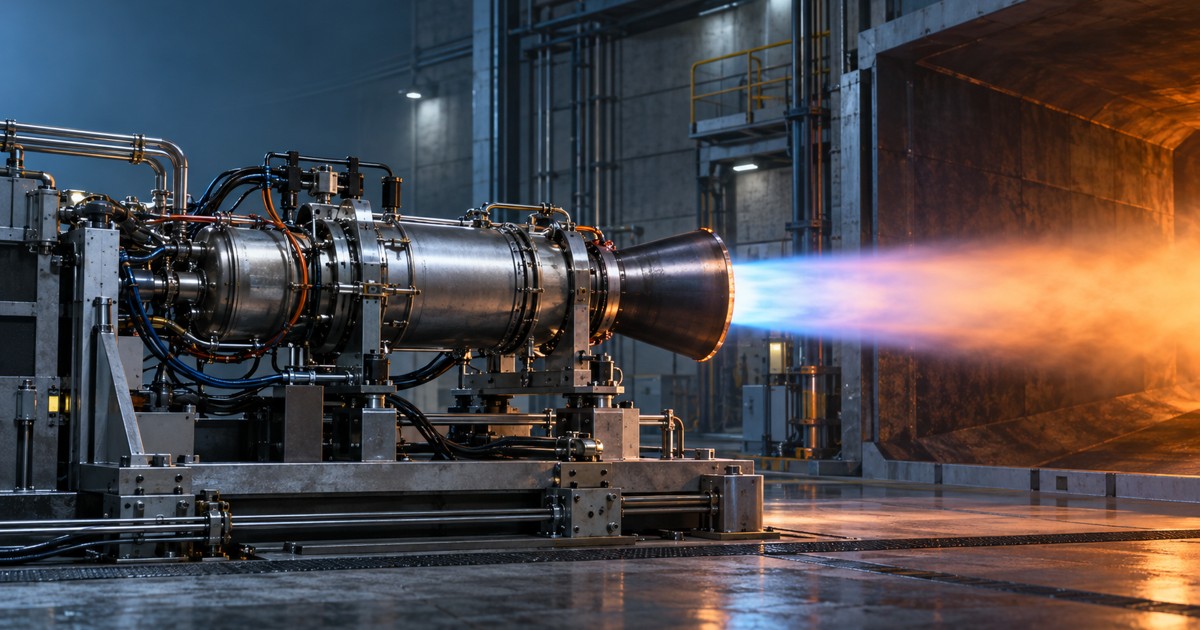
Agnikul Cosmos has shared a test firing of an electric motor-driven, pump-fed version of its Agnilet rocket engine as it prepares for Mission-02. The company’s November 18, 2026 update describes the engine being throttled up and down on the ground.
It is a development update about propulsion testing. It is not an announcement that Mission-02 has launched, that the engine has completed flight qualification or that a commercial launch service is ready to operate.
What Agnikul says is different
In its account of the test, Agnikul distinguishes the current pump-driven Agnilet from the pressure-fed engine it says flew on Agnibaan SOrTeD during Mission-01.
The company describes the tested version as electric motor-driven and says the engine remains single-piece, fully 3D-printed and semi-cryogenic. It adds that the pumps are 3D-printed too. These are the company’s descriptions of its hardware, not specifications independently measured for this article.
The distinction between the earlier flight and the current test matters. A flight record for one version does not, on its own, establish that a changed propulsion arrangement is ready for flight.
Why a ground test is useful
The update focuses on throttling: the engine’s operating level is increased and then reduced. Agnikul points to changes in the visible exhaust pattern during that sequence.
A ground firing lets a development team operate hardware in a test setting before relying on it during a mission. But a public description of one firing does not supply the full test record. The company’s post does not give the measured thrust range, total test duration or a completed qualification programme.
Those limits should remain visible when reading a short video update. An exhaust plume can show an engine operating. It cannot, by itself, prove reliability over repeated missions, a certain payload capability or a cost advantage over competing launch systems.
The facility is part of the update
Agnikul also says the firing brings its older horizontal semi-cryogenic engine test facility back into use. According to the company, that will allow engine testing and flight-qualification activities to happen in parallel.
That is a statement about how development work can be organised. It should not be shortened into a claim that flight qualification has already finished. The ability to conduct activities alongside each other is different from reporting their results.
For readers following Indian space manufacturing, the update therefore has two parts: a change in the engine’s feed arrangement and additional testing capacity being brought into use.
What would show the next stage of progress?
The next useful evidence would be a fuller test summary, qualification updates and a confirmed mission announcement from the company or the relevant authorities. This article does not infer a launch date from the words Mission-02 preparation.
It also does not treat 3D printing as proof that every part is simpler, cheaper or more reliable. Manufacturing choices need to be judged alongside measured performance and repeatable operation.
The narrow conclusion is still meaningful: Agnikul has reported a ground firing of its pump-driven Agnilet while preparing its next mission. Keeping a test milestone separate from a flight milestone gives a clearer account of progress than treating the two as interchangeable.
This report is based on Agnikul’s November 18 company update and corroborating coverage. It does not independently certify engine performance, flight readiness or commercial economics.
From our network: Visit Stockmarket360 for separate company-news and market explainers. A technology test alone does not establish a business’s valuation or future returns.