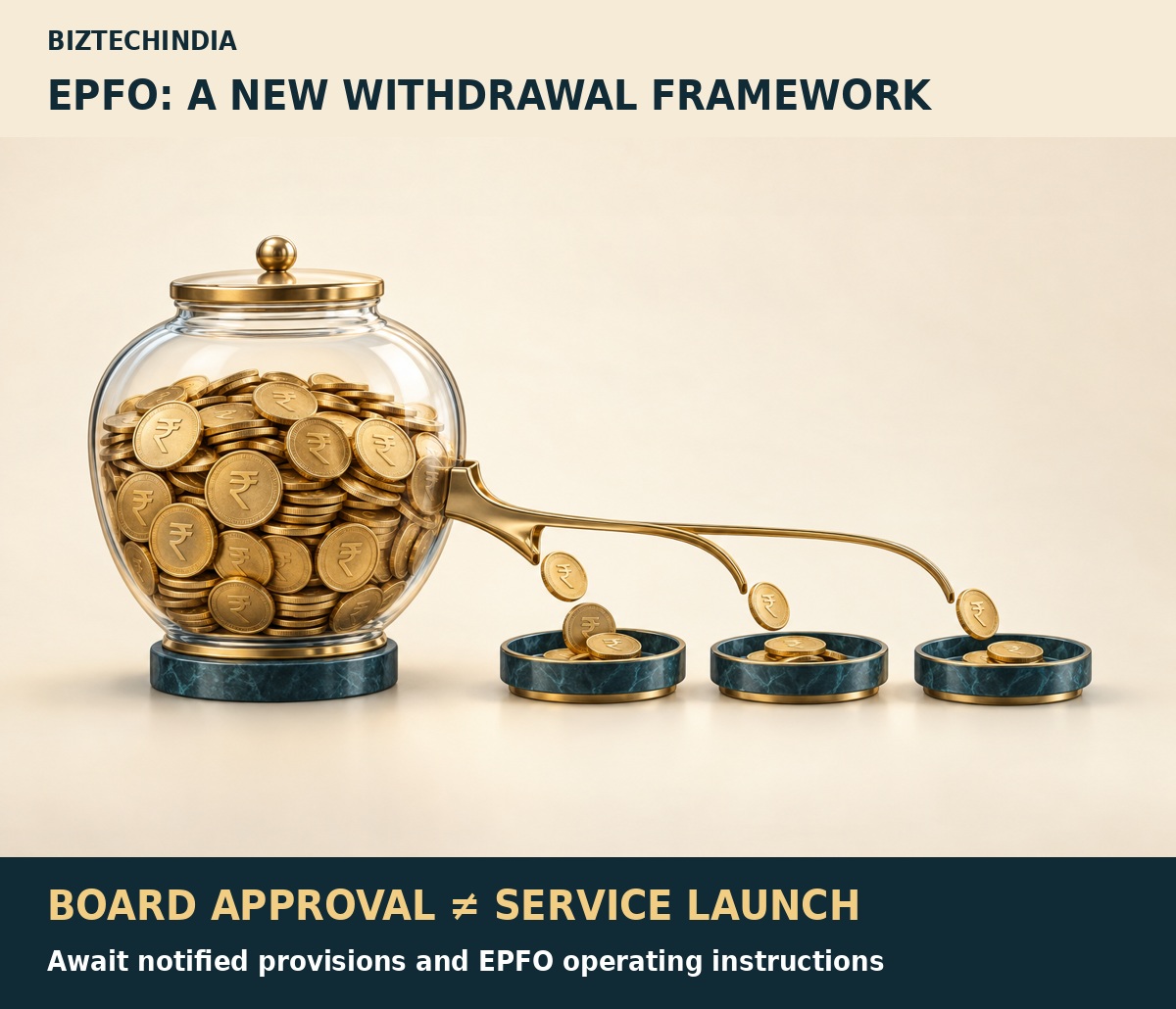
EPFO’s board has approved a voluntary plan for retirement savings to be paid in instalments, alongside a lower retained-balance requirement and a shorter wait for final provident-fund withdrawal. The decisions were announced after the Central Board of Trustees met on November 19, 2026. The important distinction for members is between a board decision and a facility they can actually use.
The Labour Ministry’s statement says the necessary EPF scheme amendments will be notified after ministry approval. That is not an invitation to start an application for the new systematic withdrawal facility today. Members should wait for the notified provisions and EPFO’s operating instructions rather than assume a news headline has changed the options in their account.
Three decisions, three different questions
- How can retirement savings be drawn down? The approved Systematic Withdrawal Plan would let retiring EPF members take periodic payments instead of withdrawing the entire balance at once.
- How much must remain in the account? The board approved reducing the minimum retained PF balance from 25% to 10%. This concerns access to a member’s savings, not a new employer contribution rate.
- How long is the wait for final settlement? The board approved reducing the waiting period from 12 months to two months. Indian Express reports that this is the final PF settlement rule after unemployment, not the separate pension-withdrawal timetable.
These decisions should not be collapsed into a claim that every member can withdraw 90% for any reason immediately. Eligibility, permitted purposes, documentation and the applicable notified provisions still matter. The ministry’s announcement is the basis for this explainer; it is not a substitute for the instructions governing an individual claim.
The retirement plan is a way to use an existing corpus
Under the approved framework, participation would be voluntary. Members could receive payments at intervals such as monthly, quarterly or half-yearly while the money not yet withdrawn remains within the EPF system and continues generating returns. The ministry also describes continuation rights for a nominee or dependent after the member’s death: the remaining balance could be withdrawn or periodic payments continued.
A periodic withdrawal is not automatically a new pension or an extra government-funded payment. It is a method of drawing from the member’s accumulated provident-fund savings. Regular payments also do not mean the underlying corpus is unlimited. How long a balance lasts depends on the eventual rules and the amounts taken out.
The release estimates that about 6.32 lakh members above 55 with PF savings exceeding Rs 5 lakh could be initial beneficiaries. That estimate describes a potential group; it does not establish a universal eligibility test. The final provisions, rather than that estimate alone, must settle who can enrol.
EPF savings are not the same as EPS pension
The Employees’ Provident Fund and the Employees’ Pension Scheme are different parts of the retirement framework. Indian Express reports that the minimum period for final pension withdrawal remains 36 months. A two-month PF settlement headline should therefore not be read as a two-month pension-withdrawal rule or a change to an existing monthly EPS pension.
Nor does the announcement establish a guaranteed investment return or prove that one withdrawal method is best for every household. Access to savings and preservation of retirement income can pull in different directions. This article explains the announced decisions; it does not recommend a withdrawal or an investment.
What members should look for next
The next useful documents are the approved scheme amendments, notification and EPFO’s instructions on eligibility, payout choices, claims and family continuation. This report gives no launch date and does not treat a projected implementation timeline as a confirmed start date. Before acting, check the current EPFO process and distinguish the PF balance, the EPS component and any new facility actually enabled for the account.
For wider educational market coverage, explore Wolf of Dalal Street. The free Wolf News app offers English and Hindi coverage. This is general information, not personal financial advice.